
Game #6: Interactive Rhombus Logic and Hypergeometric Distribution
Loading the math board and drawing, please wait…
In collections
Statistics Games
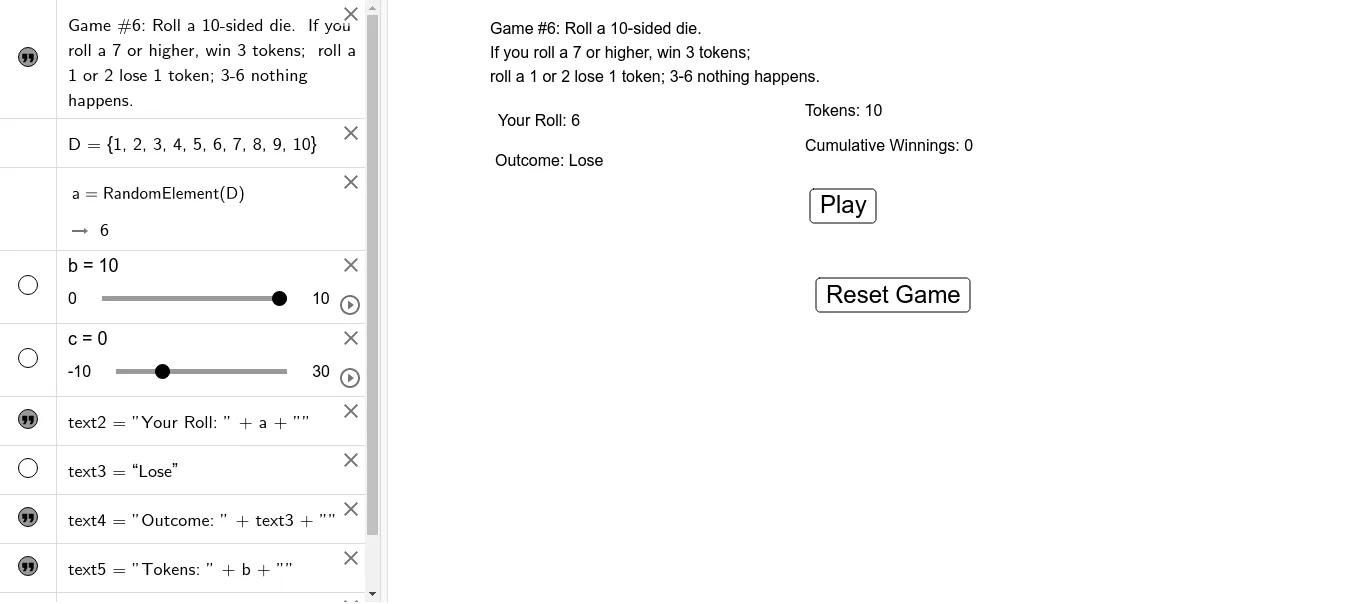
① This example, titled 'Game #6', is an interactive mathematical game built in GeoGebra that dynamically demonstrates the geometric properties of a rhombus (菱形) through random elements and conditional logic, while also incorporating logarithmic functions and the hypergeometric distribution from probability and statistics. ② The core mathematical concepts include the definition and properties of a rhombus, logical reasoning with If statements, random element selection via RandomElement, logarithmic functions, and hypergeometric probability calculations, showcasing an interdisciplinary blend of geometry, algebra, and probability. ③ Construction highlights: Based on the construction summary, the example uses the RandomElement command to generate random values, the If command for conditional branching, and creates multiple text objects (text1 through text6) to display questions, hints, or results, along with two buttons (button1, button2) to control the game flow or refresh random states; objects D, a, b, c likely represent vertices or side lengths of the rhombus. ④ This is suitable for upper secondary to early university students, serving as a gamified learning tool to reinforce rhombus geometry, logical reasoning, and probability distributions, and can also be a reference for teachers designing interactive math activities.
GeoGebra Commands & Parameters
RandomElement(D) → aIf(a > 6, "Win", "Lose") → text3
AI Drawing Prompt Reference
Create an interactive math game interface featuring a rhombus in the center, with its vertices or side lengths generated by random selection. Next to the rhombus, display a conditional outcome: if the random value exceeds 6, show 'Win', otherwise show 'Lose'. Include multiple text areas for questions, hints, and results, along with two buttons to refresh random states or advance the game. Keep the design clean and educational, blending geometric shapes with probability logic.
The prompt above was compiled from the original drawing commands and is for reference only.