
Further Transformations of Sine Functions
Loading the math board and drawing, please wait…
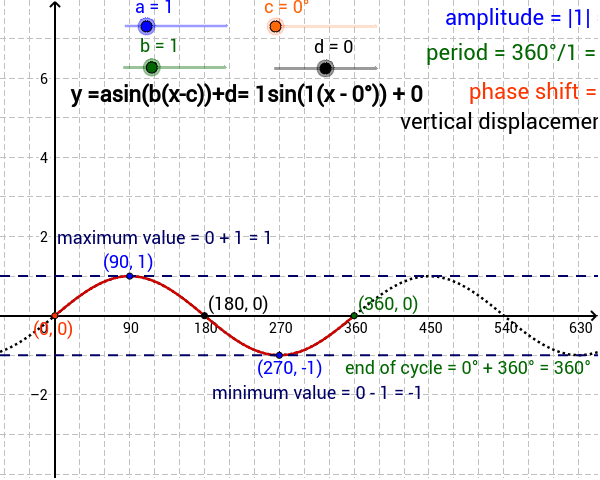
This example demonstrates how to analyze the graphs of sine functions by adjusting parameters for amplitude, period, phase shift, and vertical displacement. It focuses on the general form y = A sin(B(x ‑ C)) + D, explaining how each parameter influences the shape, position, and scale of the sinusoidal curve. Using GeoGebra’s Function command, the construction creates dynamic sine curves and employs slider objects (a, b, c, d, etc.) to control amplitude, frequency, phase, and vertical shift in real time. Key points such as peaks, valleys, and transformation markers (T1‑T8) are plotted to illustrate the effects of each parameter. The interactive nature of the sliders allows students to explore how changes in amplitude affect height, how period adjustments alter wavelength, how phase shift moves the graph horizontally, and how vertical displacement lifts or lowers the entire curve. Designed for high‑school and early‑university mathematics courses, the example serves teachers and learners seeking an exploratory tool to understand trigonometric function transformations. It supports curriculum goals in function graphing, trigonometric identities, and geometric transformations, providing a hands‑on approach to mastering sine function behavior.
GeoGebra Commands & Parameters
Function(f, c / °, c / ° + 360 / b) → g
AI Drawing Prompt Reference
Create an interactive sine function graph with sliders that control amplitude, frequency, phase, and vertical displacement, so the curve updates in real time. Draw the sine curve over one full period starting from the current phase angle, making the horizontal starting point and wavelength easy to observe. The graph should clearly show how changing amplitude affects height, changing frequency affects period, changing phase shifts the curve horizontally, and changing vertical displacement moves the whole curve up or down.
The prompt above was compiled from the original drawing commands and is for reference only.