
Function Addition Example
Loading the math board and drawing, please wait…
In collections
CCSS Support Math II Unit 2
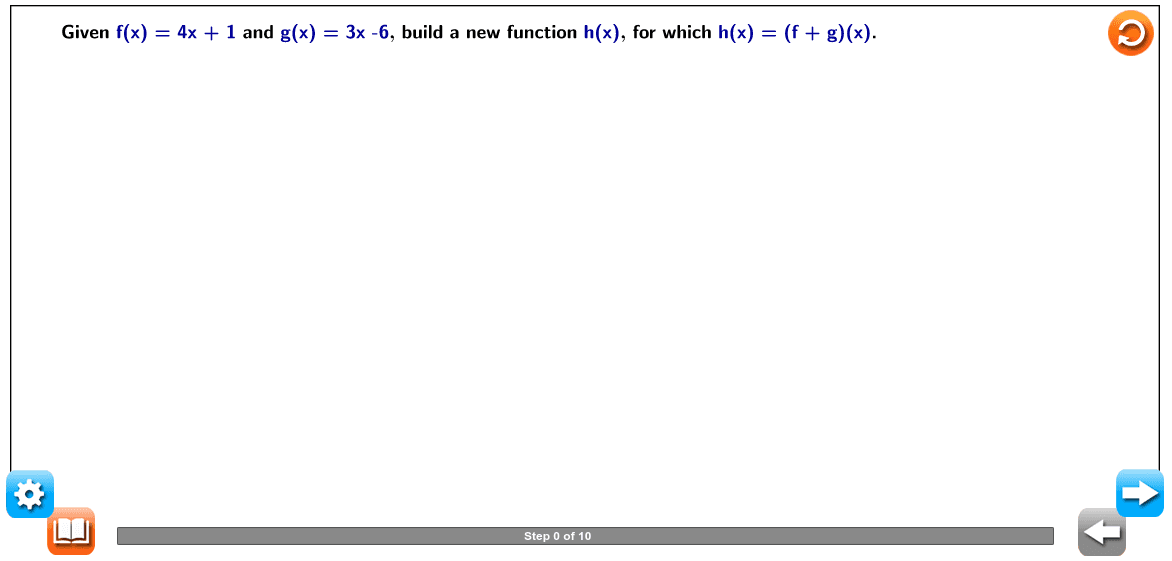
This example demonstrates how to construct a new function h(x) = (f + g)(x) given the linear functions f(x) = 4x + 1 and g(x) = 3x - 6. The key mathematical concept involved is function addition. The construction summary mentions the use of Border, Gear, Book, etc. It is suitable for students at the junior high school level and above.
GeoGebra Commands & Parameters
SelectedElement(FXC) → FXCVSelectedElement(FXX) → FXXVSelectedElement(GXC) → GXCVSelectedElement(GXX) → GXXVLaTeX("\text{Constant of f(x):}") → DKT2LaTeX("\text{Constant of g(x):}") → DKT4LaTeX("\text{Add the two functions.}") → PG1BLaTeX("\text{\textcolor{#000099}{h(x) = (f + g)(x) = f(x) + g(x)}}") → Pg1CLaTeX("\text{Combine like terms.}") → PG2ALaTeX("\text{Clear the parentheses and reorder the expression, then combine like terms.}") → PG2BLaTeX((((((((("\text{\textcolor{#000099}{h(x) = (" * FXXV) * "x + ") * FXCV) * ") + (") * GXXV) * "x ") * GXCV) * ")}}")) → Pg2CLaTeX("\text{Equation for \textcolor{#000099}{h(x)}}") → Pg2DLaTeX((((((((("\text{\textcolor{#000099}{h(x) = " * FXXV) * "x + ") * FXCV) * " + ") * GXXV) * "x ") * GXCV) * "}}")) → text1LaTeX("\text{Remove the parentheses.}") → Pg2FLaTeX("\text{Rearrange to group like terms.}") → Pg2HLaTeX((((((((("\text{\textcolor{#000099}{h(x) = " * FXXV) * "x + ") * GXXV) * "x + ") * FXCV) * " ") * GXCV) * "}}")) → Pg2GLaTeX((((("\text{\textcolor{#000099}{h(x) = " * ADDX) * "x ") * MinusX) * "}}")) → Pg2ILaTeX("\text{Combine like terms.}") → PG2JLaTeX("\text{where \textcolor{#000099}{a ≠ 0}. The graph of any quadratic function is a parabola.}") → WTK2LaTeX((((((((("\text{Given \textcolor{#000099}{f(x) = " * FXXV) * "x + ") * FXCV) * "} and \textcolor{#000099}{g(x) = ") * GXXV) * "x ") * GXCV) * "}, build a new function \textcolor{#000099}{h(x)}, for which \textcolor{#000099}{h(x) = (f + g)(x)}.}")) → Pg1ALaTeX((((((((((((((((("\text{Because \textcolor{#000099}{f(x) = " * FXXV) * "x + ") * FXCV) * "} and \textcolor{#000099}{g(x) = ") * GXXV) * "x ") * GXCV) * "}, adding \textcolor{#000099}{f(x)} and \textcolor{#000099}{g(x)} results in \textcolor{#000099}{h(x) = (f + g)(x) = (") * FXXV) * "x + ") * FXCV) * ") + (") * GXXV) * "x ") * GXCV) * ")}.}")) → PG1DLaTeX((((((((((((("\text{The result of adding \textcolor{#000099}{f(x) = " * FXXV) * "x + ") * FXCV) * "} and \textcolor{#000099}{g(x) = ") * GXXV) * "x ") * GXCV) * "} is \textcolor{#000099}{h(x) = ") * ADDX) * "x ") * MinusX) * "}.}")) → text2LaTeX("\text{\mathbf{quadratic\;function} a function that can be written in the form \textcolor{#000099}{f(x) = ax^2 + bx + c},}") → WTK1LaTeX("\text{x-value of f(x):}") → DKT1LaTeX("\text{x-value of g(x):}") → DKT3