
Fruit Boxes Geometric Model
Loading the math board and drawing, please wait…
In collections
Cuboids & their Nets
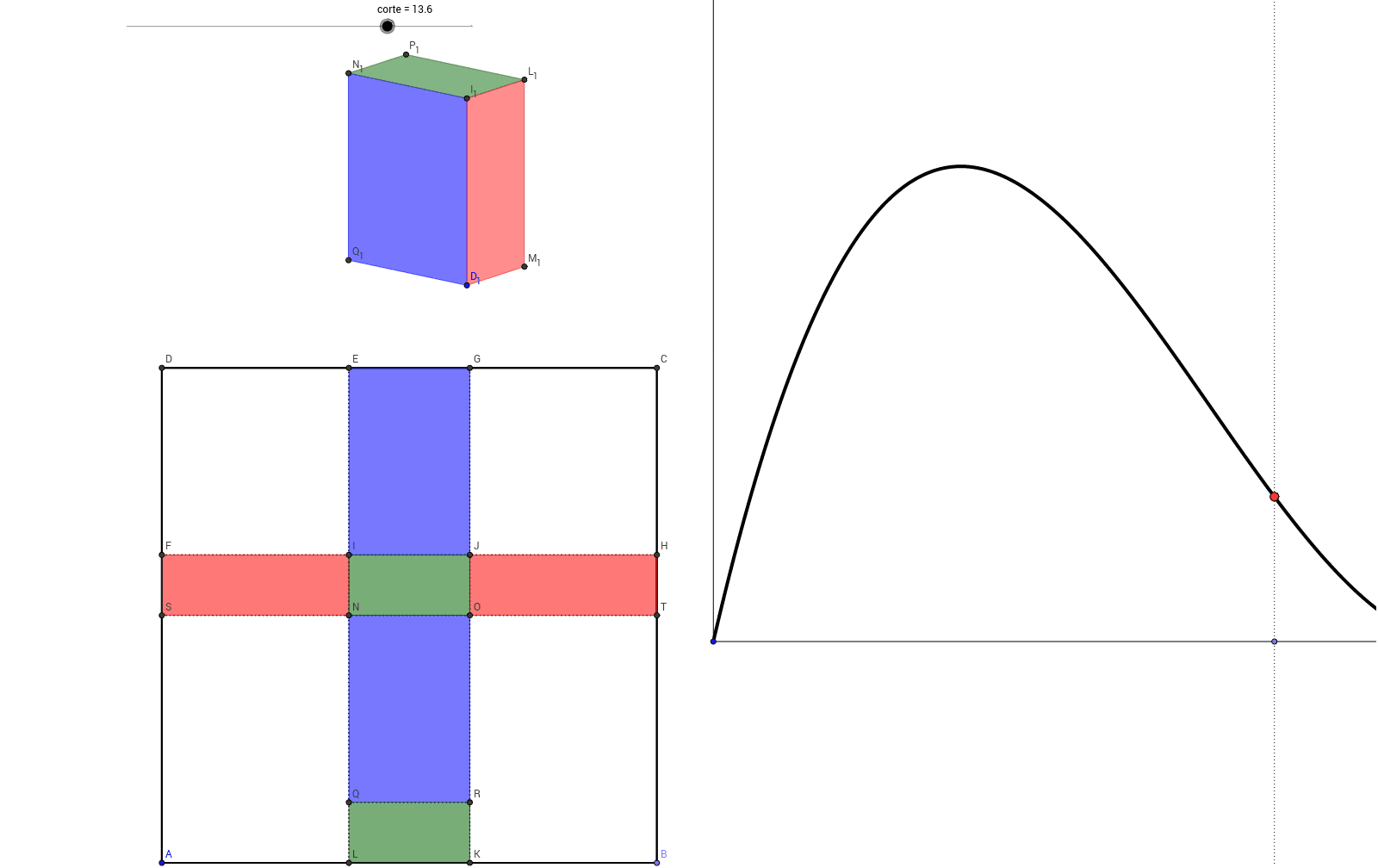
This example dynamically demonstrates the geometric construction of fruit boxes, showcasing polygonal rotations and intersection relationships. It involves core math concepts like geometric mean, percentages, rotation, standard deviation, and intersection calculations. Construction highlights include commands such as Point, Segment, Polygon, Circle, Intersect, OrthogonalLine, Tangent, Slope, Derivative, Rotate, Angle, Line, Ray, Locus. Suitable for high school mathematics teaching, integrating geometric transformations with data analysis.
GeoGebra Commands & Parameters
Point(Circle[A, 36]) → BSegment(A, B) → aPolygon(A, B, 4) → polígono1, a_1, b, c, d, C, DCircle(D, corte) → eCircle(C, corte) → gIntersect(e, c) → E,Intersect(e, d) → F,Intersect(g, c) → G,Intersect(g, b) → H,OrthogonalLine(E, c) → hOrthogonalLine(F, d) → iOrthogonalLine(G, c) → jIntersect(h, i) → IIntersect(i, j) → JIntersect(j, a_1) → KIntersect(h, a_1) → LCircle(I, 18 - corte) → kIntersect(k, h) → M, NOrthogonalLine(N, h) → lIntersect(j, l) → OCircle(N, corte) → pIntersect(p, h) → P, QOrthogonalLine(Q, h) → mIntersect(j, m) → RSegment(E, L) → nSegment(Q, R) → qSegment(F, H) → rSegment(G, K) → sIntersect(d, l) → SIntersect(b, l) → TSegment(S, T) → tPolygon(F, I, N, S) → polígono2, f_1, i_1, n_1, s_1Polygon(J, H, T, O) → polígono3, j_1, h_1, t_1, oPolygon(E, I, J, G) → polígono4, e_1, i_2, j_2, g_1Polygon(N, Q, R, O) → polígono5, n_2, q_1, r_1, o_1Polygon(I, N, O, J) → polígono6, i_3, n_3, o_2, j_3Polygon(Q, L, K, R) → polígono7, q_2, l_1, k_1, r_2Intersect(f, xAxis, 1) → UCircle(U, corte) → c_1Intersect(c_1, xAxis, 2) → VOrthogonalLine(V, xAxis) → b_1OrthogonalLine(W, yAxis) → d_1Intersect(d_1, b_1) → ZTangent(Z, f) → m_1Slope(m_1) → m_2Derivative(f) → f'Intersect(f', xAxis) → A_1, B_1OrthogonalLine(A_1, xAxis) → p_1Intersect(f', b_1, 1) → C_1OrthogonalLine(D_1, b) → a_2Point(a_2) → E_1Rotate(E_1, 18*°, D_1) → F_1Angle(E_1, D_1, F_1) → αLine(D_1, F_1) → b_2Point(a_2) → G_1Rotate(G_1, 348*°, D_1) → H_1Angle(H_1, D_1, G_1) → βLine(H_1, D_1) → c_2OrthogonalLine(D_1, a_2) → d_2Circle(D_1, corte) → e_2Intersect(e_2, d_2) → I_1, J_1Line(I_1, b_2) → f_2Line(I_1, c_2) → g_2Circle(I_1, 18 - corte) → h_2Intersect(h_2, f_2) → K_1, L_1OrthogonalLine(L_1, a_2) → k_2Intersect(b_2, k_2) → M_1Circle(I_1, 36 - 2 * corte) → p_2Intersect(p_2, g_2) → N_1, O_1OrthogonalLine(N_1, a_2) → l_2Line(N_1, f_2) → s_2Line(L_1, g_2) → t_2Intersect(s_2, t_2) → P_1Intersect(c_2, l_2) → Q_1Polygon(N_1, I_1, L_1, P_1) → polígono8, n_4, i_4, l_3, p_3Polygon(N_1, Q_1, D_1, I_1) → polígono9, n_5, q_3, d_3, i_5Polygon(I_1, D_1, M_1, L_1) → polígono10, i_6, d_4, m_3, l_4OrthogonalLine(R_1, b) → a_3OrthogonalLine(R_1, a_3) → b_3Point(a_3) → S_1Ray(R_1, S_1) → c_3Point(b_3) → T_1Ray(R_1, T_1) → e_3Point(Circle[R_1, corte * 3]) → U_1Segment(R_1, U_1) → f_3OrthogonalLine(U_1, c_3) → g_3Circle(U_1, volumen / 50) → h_3Intersect(h_3, g_3) → V_1, W_1Locus(W_1, corte) → lugar1
AI Drawing Prompt Reference
Draw a geometric model consisting of multiple polygons, including a circle and four polygons generated by the intersection of circles and lines. Start by drawing a circle, then use the intersection points of circles and lines to form multiple polygons, with each polygon made up of intersection points and points on the circle. Finally, draw a line tangent to a given curve and calculate its slope.
The prompt above was compiled from the original drawing commands and is for reference only.