
From Exponent to Root Notation Practice
Loading the math board and drawing, please wait…
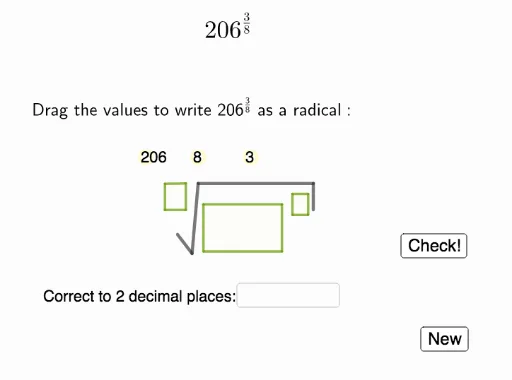
This GeoGebra example demonstrates the conversion between exponential notation (e.g., fractional exponents) and radical (root) notation, providing an interactive drill where users convert expressions and receive immediate feedback. The core mathematical concepts include the equivalence of exponents and roots, properties of powers, and simplification of radicals. Construction details: the applet uses Random and RandomElement to generate random bases and exponents, Textfield and InputBox1 for user input, Shuffle to randomize choices, Polygon and Segment to draw auxiliary shapes like trapezoids, Element to extract list items, button1 to trigger checking, and score to track performance. It is suitable for middle-to-high school students learning algebra, as well as for classroom demonstrations or self-paced practice.
GeoGebra Commands & Parameters
Random(2, 1000) → aRandomElement(list1) → bRandomElement(list2) → cTextfield(empty1) → InputBox1Shuffle(list3) → list4Polygon(A, B, C, D) → q1, a_1, b_1, c_1, dPolygon(E, F, G, H) → q2, e, f, g, hShuffle(list5) → list6Element(list6, 1) → mElement(list6, 2) → nElement(list6, 3) → oSegment(I, J) → iSegment(N, O) → jSegment(O, P) → kSegment(N, J) → lPolygon(Q, R, S, T) → q3, q_1, r, s_1, t
AI Drawing Prompt Reference
Draw a figure with three polygons, the first one formed by points A, B, C, D, the second by E, F, G, H, and the third by Q, R, S, T. Use randomly generated numbers as the coordinates of the polygon vertices, where A, B, C, D are determined by random number a and random elements b, c, and E, F, G, H, Q, R, S, T are determined by random elements. Draw auxiliary segments IJ, NO, OP, NJ to help understand the relationship between the polygons.
The prompt above was compiled from the original drawing commands and is for reference only.