
Fractions, Decimals, Percents Demo
Loading the math board and drawing, please wait…
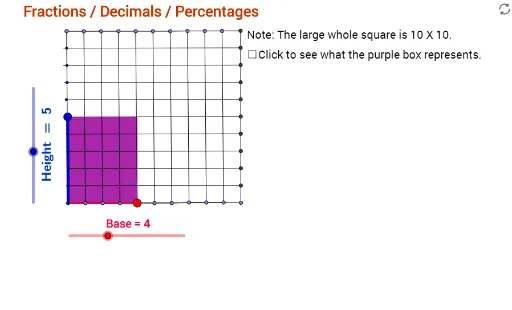
This example demonstrates the conversion relationships among fractions, decimals, and percentages through interactive graphics. It covers core math concepts including the fundamental properties of fractions, decimal representation, percentage meaning, and their equivalent conversions. Construction highlights the use of GeoGebra commands/objects like Point, Segment, OrthogonalLine, Line, Intersect, Polygon, and RotateText. Suitable for middle school and above students to visually grasp number conversions and geometric representations.
GeoGebra Commands & Parameters
Point(Circle[A, 10]) → BSegment(A, B) → aPoint(Circle[A, 1]) → CSegment(A, C) → bPoint(Circle[C, 1]) → DSegment(C, D) → cPoint(Circle[D, 1]) → ESegment(D, E) → dPoint(Circle[E, 1]) → FSegment(E, F) → ePoint(Circle[F, 1]) → GSegment(F, G) → fPoint(Circle[G, 1]) → HSegment(G, H) → gPoint(Circle[H, 1]) → ISegment(H, I) → hPoint(Circle[I, 1]) → JSegment(I, J) → iPoint(Circle[J, 1]) → KSegment(J, K) → jOrthogonalLine(A, a) → kPoint(Circle[A, 1]) → LSegment(A, L) → lPoint(Circle[L, 1]) → MSegment(L, M) → mPoint(Circle[M, 1]) → NSegment(M, N) → nPoint(Circle[N, 1]) → OSegment(N, O) → pPoint(Circle[O, 1]) → PSegment(O, P) → qPoint(Circle[P, 1]) → QSegment(P, Q) → rPoint(Circle[Q, 1]) → RSegment(Q, R) → sPoint(Circle[R, 1]) → SSegment(R, S) → tPoint(Circle[S, 1]) → TSegment(S, T) → a_1Point(Circle[T, 1]) → USegment(T, U) → b_1Line(U, a) → c_1Line(B, k) → d_1Intersect(c_1, d_1) → VLine(T, c_1) → e_1Line(S, e_1) → f_1Line(R, f_1) → g_1Line(Q, g_1) → h_1Line(P, h_1) → i_1Line(O, i_1) → j_1Line(N, j_1) → k_1Line(M, k_1) → l_1Line(L, l_1) → m_1Intersect(d_1, e_1) → WIntersect(d_1, f_1) → ZIntersect(d_1, g_1) → A_1Intersect(d_1, h_1) → B_1Intersect(d_1, i_1) → C_1Intersect(d_1, j_1) → D_1Intersect(d_1, k_1) → E_1Intersect(d_1, l_1) → F_1Intersect(d_1, m_1) → G_1Segment(V, H_1) → n_1Segment(U, V) → p_1Segment(T, W) → q_1Segment(S, Z) → r_1Segment(R, A_1) → s_1Segment(Q, B_1) → t_1Segment(P, C_1) → a_2OrthogonalLine(A, a) → b_2Segment(O, D_1) → c_2Segment(N, E_1) → d_2Segment(M, F_1) → e_2Segment(L, G_1) → f_2Point(Circle[U, 1]) → I_1Segment(U, I_1) → g_2Point(Circle[I_1, 1]) → J_1Segment(I_1, J_1) → h_2Point(Circle[J_1, 1]) → K_1Segment(J_1, K_1) → i_2Point(Circle[K_1, 1]) → L_1Segment(K_1, L_1) → j_2Point(Circle[L_1, 1]) → M_1Segment(L_1, M_1) → k_2Point(Circle[M_1, 1]) → N_1Segment(M_1, N_1) → l_2Point(Circle[N_1, 1]) → O_1Segment(N_1, O_1) → m_2Point(Circle[O_1, 1]) → P_1Segment(O_1, P_1) → n_2Point(Circle[P_1, 1]) → Q_1Segment(P_1, Q_1) → p_2Segment(C, I_1) → q_2Segment(J_1, D) → r_2Segment(K_1, E) → s_2Segment(L_1, F) → t_2Segment(M_1, G) → a_3Segment(N_1, H) → b_3Segment(O_1, I) → c_3Segment(P_1, J) → d_3Segment(Q_1, K) → e_3Segment(A, U) → f_3Point(Circle[A, Base]) → Base_1Segment(A, Base_1) → g_3Point(Circle[A, Height]) → Height_1Segment(A, Height_1) → h_3Line(Height_1, g_3) → i_3Line(Base_1, h_3) → j_3Intersect(i_3, j_3) → T_1Segment(Height_1, T_1) → k_3Segment(T_1, Base_1) → l_3Polygon(Height_1, T_1, Base_1, A) → poly1, s_3, t_3, r_3, a_4Intersect(s_1, f_3) → R_1Intersect(r_1, f_3) → S_1Intersect(q_1, f_3) → U_1RotateText(text11, 1.5707963267948966) → text12