
Fractions and Unit (Part 1)
Loading the math board and drawing, please wait…
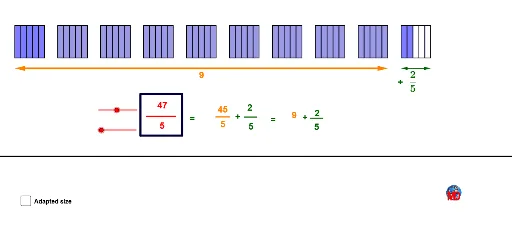
This example demonstrates how to understand and represent improper fractions through geometric methods. Core math concepts include the definition of improper fractions, geometric representation of fractions, and unit fractions. It uses commands and objects like Line, Point, Mod, Div, If, Translate, Dilate, Segment, Polygon, Sequence, Midpoint, Vector in GeoGebra for construction and calculation. Suitable for middle school and above learners to grasp the geometric meaning and operations of fractions.
GeoGebra Commands & Parameters
Line(A, xAxis) → qPoint(q) → BLine(A, yAxis) → pMod(Numerator, Denominator) → rs2Div(Numerator, Denominator) → QuotIf(rs2 < nn, rs2, nn - 1) → resultPoint(q) → FTranslate(D, Vector[(Quot * Vector[E, F])]) → D'Dilate(B, 1 / nn, A) → B'Point(p) → CSegment(A, B) → aSegment(A, C) → bTranslate(D, Vector[A, B]) → D'_1Translate(D, Vector[A, C]) → D'_2Translate(D'_2, Vector[A, B]) → D''_1Segment(E, F) → cPolygon(D, D'_1, D''_1, D'_2) → poly2, d_1, d'_1, d'', d'Sequence(Polygon[Translate[D, Vector[(i * Vector[E, F])]], Translate[D'_1, Vector[(i * Vector[E, F])]], Translate[D''_1, Vector[(i * Vector[E, F])]], Translate[D'_2, Vector[(i * Vector[E, F])]]], i, 1, Quot - 1) → list1Translate(D', Vector[A, B]) → D''_2Translate(D', Vector[A, C]) → D''_3Translate(D''_3, Vector[A, B]) → D'''_1Segment(D', D''_2) → dSegment(D''_2, D'''_1) → eSegment(D''_3, D'''_1) → fSegment(D''_3, D') → gSequence(Segment[Translate[D''_3, Vector[(i * Vector[A, B'])]], Translate[D', Vector[(i * Vector[A, B'])]]], i, 1, nn - 1) → list2Translate(D', Vector[(result * Vector[A, B'])]) → D''Translate(D'', Vector[A, C]) → D'''Polygon(D', D'', D''', D''_3) → poly3, d'_2, d''_1, d''', d''_3Segment(G, H) → iSegment(I, J) → hSequence(Segment[Translate[D, Vector[(i * Vector[A, B'])]], Translate[D'_2, Vector[(i * Vector[A, B'])]]], i, 1, Denominator - 1) → list3Sequence(Sequence[Segment[Translate[Translate[D, Vector[(j * Vector[E, F])]], Vector[(i * Vector[A, B'])]], Translate[Translate[D'_2, Vector[(j * Vector[E, F])]], Vector[(i * Vector[A, B'])]]], i, 1, Denominator - 1], j, 1, Quot - 1) → list4Mod(Numerator, Denominator) → rest22Polygon(A, B, M, C) → poly1, a_1, b_1, m_1, c_1Sequence(Polygon[Translate[D, Vector[(i * Vector[E, F])]], Translate[D'_1, Vector[(i * Vector[E, F])]], Translate[D''_1, Vector[(i * Vector[E, F])]], Translate[D'_2, Vector[(i * Vector[E, F])]]], i, 1, Quot - 1) → liste1Sequence(Segment[Translate[D''_3, Vector[(i * Vector[A, B'])]], Translate[D', Vector[(i * Vector[A, B'])]]], i, 1, nn - 1) → liste2Sequence(Segment[Translate[D, Vector[(i * Vector[A, B'])]], Translate[D'_2, Vector[(i * Vector[A, B'])]]], i, 1, Denominator - 1) → liste3Sequence(Sequence[Segment[Translate[Translate[D, Vector[(j * Vector[E, F])]], Vector[(i * Vector[A, B'])]], Translate[Translate[D'_2, Vector[(j * Vector[E, F])]], Vector[(i * Vector[A, B'])]]], i, 1, Denominator - 1], j, 1, Quot - 1) → liste4Translate(A, Vector[B, F]) → A'Translate(B, Vector[B, F]) → B'_1Translate(M, Vector[B, F]) → M'Translate(C, Vector[B, F]) → C'Polygon(A', B'_1, M', C') → poly1', a', b'_1, m', c'Midpoint(N, O) → RMidpoint(P, Q) → SVector(R, O) → uVector(R, N) → vVector(S, Q) → wVector(S, P) → zPolygon(T, U, V, W) → poly4, t, u_1, v_1, w_1Polygon(D, D'_1, D''_1, D'_2) → poly5, d_2, d'_3, d''_2, d'_4Midpoint(B, A) → ZVector(Z, B) → jVector(Z, A) → lMidpoint(A, C) → A_1Vector(A_1, C) → mVector(A_1, A) → nMidpoint(c') → B_1Midpoint(B, M) → C_1Midpoint(B_1, C_1) → D_1Vector(D_1, B_1) → rVector(D_1, C_1) → sLine(E_1, F_1) → e_1Segment(G_1, H_1) → f_1Segment(I_1, J_1) → g_1
AI Drawing Prompt Reference
Draw a coordinate plane with a horizontal baseline and a vertical line through a starting point. Mark a unit segment on the baseline. Based on the given numerator and denominator, compute the whole number part and the remainder. Repeat the unit segment horizontally that many times to form several complete unit rectangles. In the last rectangle, divide the vertical side into equal parts according to the denominator, draw the division lines, and shade the region representing the remainder. The final figure illustrates how an improper fraction consists of whole units plus a fractional part.
The prompt above was compiled from the original drawing commands and is for reference only.