
Fraction Visualizer: Show Fractions with Circles and Polygons
Loading the math board and drawing, please wait…
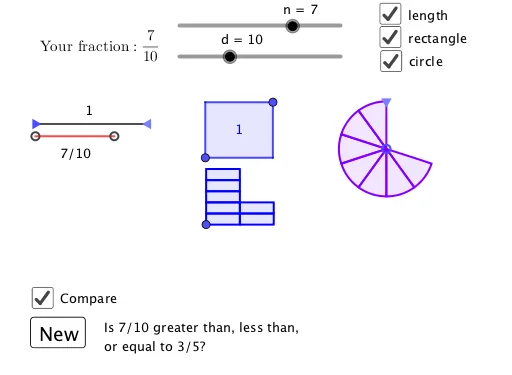
① This example visualizes fractions dynamically using geometric shapes like circles, polygons, and pyramids to illustrate the relationship between parts and wholes. ② Core math concepts include fractions, area, geometric figures (circle, polygon), and also touches on statistical measures like median and variance, but the main focus is on the geometric representation of fractions. ③ Construction highlights: It employs GeoGebra commands such as RandomElement, Random, Point, Segment, Polygon, Midpoint, If, Sequence, and Translate, with numerous objects (d, D, n, N, r, l1, a, b, D2, c, d_1, l2, N2, e, A, B, C, E, f, g, h, F, G, q1, f_1, i, g_1, j, H, text2, l3, k, I, J, K, L, M, q2, f_2, k_1) to create random and sequenced fraction representations. ④ Suitable for upper elementary to middle school students, this is ideal for classroom demonstrations of fraction concepts and for teachers creating interactive fraction lessons.
GeoGebra Commands & Parameters
RandomElement(l1) → aRandom(floor(d / 2), ceil((1.5 * d))) → bRandom(1, a) → cRandomElement(l2) → ePoint(Ray[A, A + (1, 0)]) → BSegment(A, B) → fSegment(E, C) → gPolygon(F, (x(G), y(F)), G, (x(F), y(G))) → q1, f_1, i, g_1, jMidpoint(g) → HIf(¬k, Midpoint[I, F], I) → KIf(¬k, F + (2 / D * (J - F)), F + (1 / D * (J - F))) → LPolygon(F, K, M, L) → q2, f_2, k_1, m, lSequence(Polygon[Translate[F, (i * (L - F))], Translate[K, (i * (L - F))], Translate[M, (i * (L - F))], Translate[L, (i * (L - F))]], i, 0, If[k, N, Min[N, D / 2]] - 1) → l4If((¬k) ∧ N > D / 2, Sequence[Translate[Polygon[Translate[F, K - F], Translate[K, K - F], Translate[M, K - F], Translate[L, K - F]], (i * (L - F))], i, 0, N - D / 2 - 1]) → l5Point(Ray[O, O + (0, 1)]) → PSequence(Rotate[CircleSector[O, P, Rotate[P, (360°) / D, O]], (i * (360°) / D), O], i, 0, N - 1) → l6Translate({l4, l5}, Q - F) → l7