
Fraction Division: a ÷ b (Partitive Division)
Loading the math board and drawing, please wait…
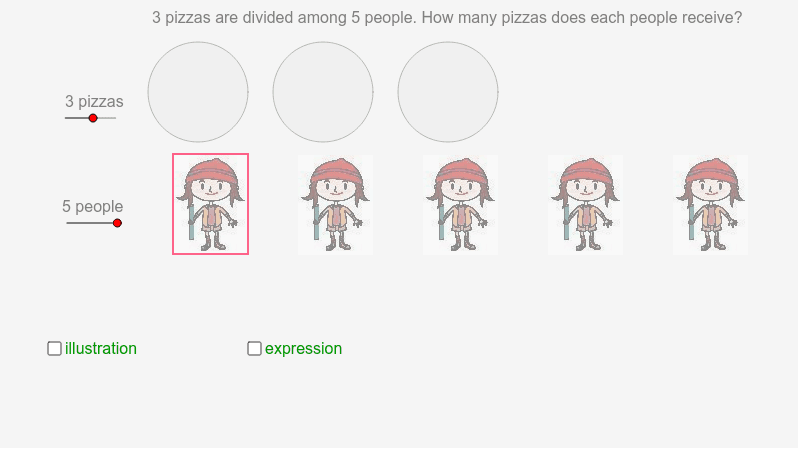
This example demonstrates the concept of a ÷ b = a/b through partitive division. It uses various GeoGebra commands such as Point, Segment, Sequence, Polygon, etc., to create an intuitive geometric model. Suitable for students at the junior high school level and above to learn the concept of fraction division and its geometric meaning.
GeoGebra Commands & Parameters
Point(Segment[(x(D) + 2 / 5, y(D)), (x(D) + 1, y(D))]) → SSegment(A, (x(A) + 1, y(A))) → l1Point(Segment[(x(A) + 1 / 5, y(A)), (x(A) + 1, y(A))]) → PSegment(B, (x(B) + 1, y(B))) → l2Point(Segment[(x(B) + 2 / 6, y(B)), (x(B) + 1, y(B))]) → QPoint(Segment[(x(C) + 1 / 6 - 0.0050, y(C)), (x(Q) - 1 / 6, y(C))]) → RSegment(C, (x(C) + 1, y(C))) → l3Sequence(Circle[(2.5 * (i - 1), 0), 1], i, 1, a) → list1Sequence(Segment[(2.5 * a, 0), (2.5 * a - sin(j * θ), cos(j * θ))], j, 1, c - 1) → list2Segment(D, (x(D) + 1, y(D))) → l4Polygon((-0.5, -3.24), (1, -3.24), (1, -1.24), (-0.5, -1.24)) → poly1, e, g, h, iGCD(a, d) → kSegment(A, P) → jSegment(C, R) → lSegment(B, Q) → mSegment(D, S) → nPoint(Segment[(x(A_1) + 1 / 7, y(A_1)), (x(A_1) + 1, y(A_1))]) → P_1Segment(A_1, P_1) → j_1Point(Segment[(x(D_1) + 2 / 5, y(D_1)), (x(D_1) + 1, y(D_1))]) → S_1Point(Segment[(x(A_2) + 1 / 7, y(A_2)), (x(A_2) + 1, y(A_2))]) → P_2GCD(a_1, d_1) → k_1Segment(A_2, P_2) → j_2Segment(D_1, S_1) → n_1Point(Segment[(x(D_2) + 2 / 5, y(D_2)), (x(D_2) + 1, y(D_2))]) → S_2Point(Segment[(x(A_3) + 1 / 7, y(A_3)), (x(A_3) + 1, y(A_3))]) → P_3GCD(a_2, d_2) → k_2Segment(A_3, P_3) → j_3Segment(D_2, S_2) → n_2Sequence(Sequence[CircleSector[(-1 * f * sin((2 * k - 1) * θ / 2) + 2.5 * (m - 1), f * cos((2 * k - 1) * θ / 2)), (-1 * f * sin((2 * k - 1) * θ / 2) - sin((k - 1) * θ) + 2.5 * (m - 1), f * cos((2 * k - 1) * θ / 2) + cos((k - 1) * θ)), (-1 * f * sin((2 * k - 1) * θ / 2) - sin(k * θ) + 2.5 * (m - 1), f * cos((2 * k - 1) * θ / 2) + cos(k * θ))], k, 1, 1], m, 1, a) → list4Sequence(Sequence[CircleSector[(f * sin((2 * k - 1) * θ / 2) + 2.5 * (m - 1), f * cos((2 * k - 1) * θ / 2)), (f * sin((2 * k - 1) * θ / 2) + sin(k * θ) + 2.5 * (m - 1), f * cos((2 * k - 1) * θ / 2) + cos(k * θ)), (f * sin((2 * k - 1) * θ / 2) + sin((k - 1) * θ) + 2.5 * (m - 1), f * cos((2 * k - 1) * θ / 2) + cos((k - 1) * θ))], k, 1, b], m, 1, a) → list3
AI Drawing Prompt Reference
Create a geometric model to demonstrate the concept of fraction division, showing a ÷ b as taking a part of a line segment divided into b equal parts. Start by drawing a line segment D, then create points S and A on it, and draw vertical line segments from A and S. Next, create points B and Q on the segment, and draw vertical line segments from B and Q. Connect A to P, B to Q, C to R, and D to S. Finally, draw a series of circles and sectors to represent the geometric meaning of fractions.
The prompt above was compiled from the original drawing commands and is for reference only.