
Fraction Comparison: More or Less than 1/4, 1/2, or 3/4 Card Game
Loading the math board and drawing, please wait…
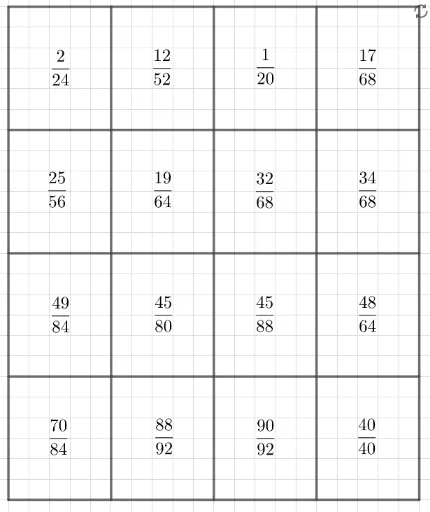
① This example demonstrates a card-shuffling game where students compare fractions to benchmark values like 1/4, 1/2, and 3/4, reinforcing intuitive understanding of fraction magnitude. ② Core math concepts include fraction comparison, benchmark fractions, and number sense. ③ Construction uses GeoGebra commands Sequence and Random to generate random fraction cards, with multiple point objects (A1-B16) and auxiliary objects (C1-C6) to create the card layout and interactive shuffle mechanism. ④ Suitable for upper elementary or early middle school students, this activity serves as a classroom game or practice tool to build quick mental estimation of fraction sizes relative to key benchmarks.
GeoGebra Commands & Parameters
Sequence(Segment[(0, (6 * n)), (20, (6 * n))], n, 0, 4) → l2Sequence(Segment[((5 * n), 0), ((5 * n), 24)], n, 0, 4) → l1Random(3, 25) → A1Random(3, 25) → A2Random(3, 25) → A3Random(3, 25) → A4Random(3, 25) → A5Random(3, 25) → A6Random(3, 25) → A7Random(3, 25) → A8Random(3, 25) → A9Random(3, 25) → A10Random(3, 25) → A11Random(3, 25) → A12Random(3, 25) → A13Random(3, 25) → A14Random(3, 25) → A15Random(3, 25) → A16Random(1, B1 / 4) → C1Random(1, B2 / 4) → C2Random(1, B3 / 4) → C3Random(B5 / 4 + 1, B5 / 2 - 1) → C5Random(B6 / 4 + 1, B6 / 2 - 1) → C6Random(B7 / 4 + 1, B7 / 2 - 1) → C7Random(B9 / 2 + 1, (3 * B9 / 4) - 1) → C9Random(B10 / 2 + 1, (3 * B10 / 4) - 1) → C10Random(B11 / 2 + 1, (3 * B11 / 4) - 1) → C11Random((3 * B13 / 4) + 1, B13 - 1) → C13Random((3 * B14 / 4) + 1, B14 - 1) → C14Random((3 * B15 / 4) + 1, B15 - 1) → C15
AI Drawing Prompt Reference
Draw a card game board for comparing fractions: create a 4x4 grid formed by five equally spaced horizontal and vertical lines, resulting in 16 card slots. In each slot, place a randomly generated fraction with a numerator between 3 and 25 and a denominator that is a multiple of 4. Some fractions are intentionally less than 1/4, some between 1/4 and 1/2, some between 1/2 and 3/4, and some greater than 3/4, to represent different comparison ranges. Add reference labels for the benchmark fractions 1/4, 1/2, and 3/4 near the grid. The layout should be clear and suitable for students to quickly judge each fraction's size relative to the benchmarks.
The prompt above was compiled from the original drawing commands and is for reference only.