
Fraction Addition by ROHIT ROY
Loading the math board and drawing, please wait…
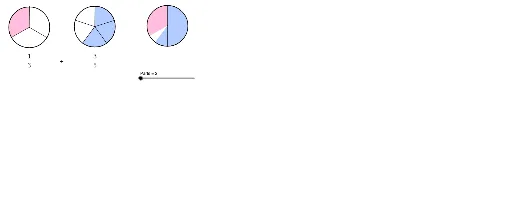
This example demonstrates the process of adding fractions. Key mathematical concepts include fraction addition and least common multiple. Using GeoGebra commands such as Circle, Sequence, Sector, Point, etc., it visually illustrates the geometric meaning of fraction addition. Suitable for high-grade elementary or junior high school students.
GeoGebra Commands & Parameters
Circle(A, B) → cSequence(Rotate[B, i°, A], i, 0, 360, 360 / Den1) → l1Sequence(Segment[A, Element[l1, k]], k, 1, Den1) → l2Sector(c, B, Element[l1, Num1 + 1]) → dSequence(Rotate[B_1, i°, A_1], i, 0, 360, 360 / Den2) → l1_1Circle(A_1, B_1) → c_1Sector(c_1, Element[l1_1, Den2 - Num2 + 1], B_1) → d_1Point(l1) → CLine(B, B_1) → fLine(A, A_1) → gPoint(g) → DPoint(f) → ECircle(D, E) → eIntersect(e, f) → F, GVector(B_1, F) → uVector(B, F) → vTranslate(d, v) → d'Translate(d_1, u) → hIntersect(e, d', 1) → HSequence(Rotate[H, t°, D], t, 0, 360, 360 / Ans) → l3Sequence(Segment[D, Element[l3, k]], k, 1, Ans) → l4Sequence(Segment[A_1, Element[l1_1, k]], k, 1, Den2) → l2_1LCM(Den1, Den2) → aLCM(Den1, Den2) → bProduct({b / Den1, Num1}) → iProduct({b / Den2, Num2}) → j
AI Drawing Prompt Reference
Draw two circles with centers at points A and A1, both with radius 1. On the first circle, draw a sector with angle determined by point B and size as numerator1 divided by denominator1. On the second circle, draw a sector with angle determined by point B1 and size as numerator2 divided by denominator2. Connect points A and A1, and B and B1. Find the intersection points D and E of the two lines, then draw a circle with D and E as centers. Find the intersection points F and G of the two lines, draw vectors u and v. Translate the first sector along vector v, and the second sector along vector u. Find the intersection of the translated first sector with line f, rotate this intersection H around point D to form a series of sectors, and draw the edges of these sectors. Finally, calculate the least common multiple of denominator1 and denominator2 to get results i and j.
The prompt above was compiled from the original drawing commands and is for reference only.