
Fractions on Number Line
Loading the math board and drawing, please wait…
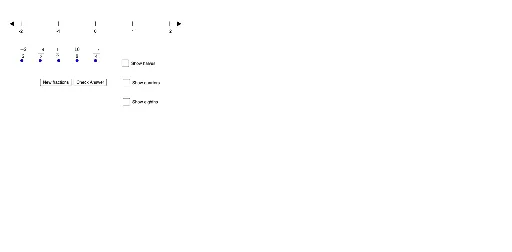
This example demonstrates how to represent fractions on a number line. Key mathematical concepts include the representation and comparison of fractions. Using GeoGebra commands such as Sequence, Segment, and Element, the example dynamically shows the position of fractions on the number line. Suitable for high-grade elementary and junior high school students to learn about fractions.
GeoGebra Commands & Parameters
Sequence(RandomElement[dens], i, 1, 5) → list6_1Sequence(Element[list7, i] / Element[list6, i], i, 1, 5) → flistSequence((-x(Element[list8, i])) + Element[flist, i] > error, i, 1, 5) → toosmallSequence(x(Element[list8, i]) - Element[flist, i] > error, i, 1, 5) → toobigSegment(A, B) → f_1Sequence(Segment[(-2 + i, -0.12), (-2 + i, 0.12)], i, 0, 4, 1) → list1Sequence(Segment[(-2 + i, -0.11), (-2 + i, 0.11)], i, 0, 4, 0.5) → list3Sequence(Segment[(-2 + i, -0.09), (-2 + i, 0.09)], i, 0, 4, 0.25) → list4Sequence(Segment[(-2 + i, -0.07), (-2 + i, 0.07)], i, 0, 4, 0.125) → list5Sequence(Text[-2 + i, (x(C) + (1.02 * i), y(C))], i, 0, 4) → list2Sequence(Element[flist, i], i, 1, 5) → dElement(P, 1) → UElement(P, 2) → VElement(P, 3) → WElement(P, 4) → ZElement(P, 5) → A_1Sequence(Random[(-2 * Element[list6_1, i]), (2 * Element[list6_1, i])], i, 1, 5) → list7_1Frequency(l1) → l2Max(l2) → jIf(j ≠ 1, true, false) → k
AI Drawing Prompt Reference
Draw a number line from -2 to 2. Randomly place 5 fraction points on the number line, each represented by a small segment. Connect the fraction points with line segments. Write the corresponding fraction value next to each point. Ensure the fraction points are correctly positioned on the number line with an error no more than 0.12.
The prompt above was compiled from the original drawing commands and is for reference only.