
Fractal Spirograph by Juan Carlos Ponce Campuzano
Loading the math board and drawing, please wait…
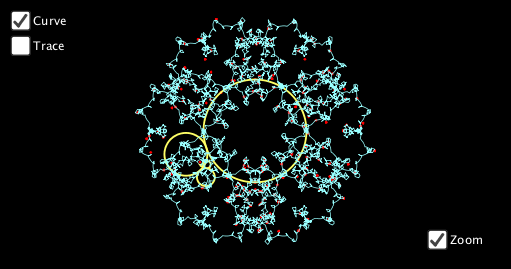
This example demonstrates the creation of a fractal spirograph by rotating and dilating circles, involving concepts like rotation, dilation, locus, and parametric equations. It uses commands such as Rotate, Circle, Dilate, Locus, and TableText in GeoGebra. Suitable for high school and above students to explore complex geometric properties.
GeoGebra Commands & Parameters
Rotate((3, 0), a) → A_0Circle((0, 0), 3) → c_0Dilate(c_0, -1 / b, A_0) → c_1Rotate(A_0, (k * ((-a) + (3 * π / 2))), Center[c_1]) → A_1Dilate(c_1, -1 / b, A_1) → c_2Rotate(A_1, (k^(2) * (a + π / 2)), Center[c_2]) → A_2Dilate(c_2, -1 / b, A_2) → c_3Rotate(A_2, (k^(3) * (a + π / 2)), Center[c_3]) → A_3Dilate(c_3, -1 / b, A_3) → c_4Rotate(A_3, (k^(4) * (a + π / 2)), Center[c_4]) → A_4Dilate(c_4, -1 / b, A_4) → c_5Rotate(A_4, (k^(4) * (a + π / 2)), Center[c_5]) → A_5Dilate(c_5, -1 / b, A_5) → c_6Rotate(A_5, (k^(4) * (a + π / 2)), Center[c_6]) → A_6Dilate(c_6, -1 / b, A_6) → c_7Rotate(A_6, (k^(4) * (a + π / 2)), Center[c_7]) → A_7Locus(A_7, a) → loc1TableText({{LaTeX[xmax, true, true]}, {LaTeX[xmin, true, true]}, {LaTeX[ymax, true, true]}, {LaTeX[ymin, true, true]}}) → text1