
Fractal Pythagoras Tree with Macros and Transformations
Loading the math board and drawing, please wait…
In collections
Pythagoras Fractal Trees constructions
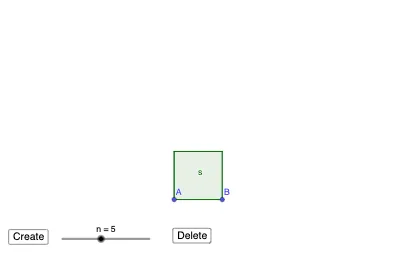
This GeoGebra example demonstrates how a Pythagoras tree fractal can be generated by repeatedly constructing right-triangle branches with consistent geometric relationships. It visualizes the self-similar growth produced by iterating a rule derived from the Pythagorean theorem. Key concepts include geometric interpretation of the Pythagorean relationship, triangle edge/angle dependencies, and parameter-controlled (and optionally stochastic-like) recursive construction that builds a fractal pattern. Construction relies on Polygon and Vertex/Point to define the initial triangle/polygon structure, Centroid to determine reference positioning, and Translate to move newly created components into place. Length and Angle are used to measure side sizes and compute the rotation angles for the left and right branches. Relevant construction parameters/controls include objects such as side, angL/angR, and sL/sR to govern branch geometry, while interactive controls (e.g., buttons and an iteration level n) drive the recursion depth and animation. Suitable for secondary mathematics enrichment and early university geometry/fractal visualization, especially for teaching how a theorem-based geometric rule yields an emergent fractal through iteration.
GeoGebra Commands & Parameters
Polygon(A, B, 4) → s, f, g, h, i, C, DCentroid(s) → C0Vertex(s, 3) → VCVertex(s, 4) → VDPoint(Semicircle[VD, VC]) → FCentroid(Polygon[F, VC, 4]) → CRCentroid(Polygon[VD, F, 4]) → CLLength(Segment[VD, F]) → dLLength(Segment[VC, F]) → dRAngle(F, VC, VD) → angRAngle(VC, VD, F) → angLTranslate(Rotate[Dilate[s, dR / side, C0], (-angR), C0], Vector[C0, CR]) → sRTranslate(Rotate[Dilate[s, dL / side, C0], angL, C0], Vector[C0, CL]) → sL
AI Drawing Prompt Reference
Draw a Pythagoras tree fractal. Start by constructing a quadrilateral s with four points A, B, C, and D, then find its centroid C0. Determine the third and fourth vertices VC and VD of s. Draw a semicircle between VD and VC and find its center F. Calculate the distances dL and dR from F to VD and VC, and the angles angL and angR. Through rotation and scaling, generate new quadrilaterals sL and sR and place them around VD and VC.
The prompt above was compiled from the original drawing commands and is for reference only.