
Four Parallelogram Properties Interactive Demo
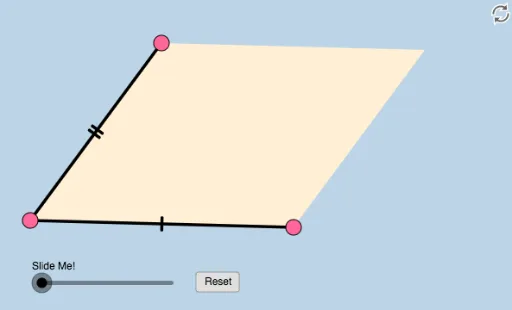
Loading the math board and drawing, please wait…
This GeoGebra example dynamically demonstrates four fundamental properties of a parallelogram: opposite sides are parallel and equal, opposite angles are equal, diagonals bisect each other, and consecutive angles are supplementary. The core mathematical concepts involve parallelogram definitions, vector translation, similarity and dilation transformations, and geometric measurement relationships. Construction highlights from the summary include using Line, Segment, and Polygon to build the base figure, Vector and Translate to replicate sides, Dilate for scaling, and PointIn and Slope to link dynamic points and slopes, with a button (button1) controlling the interactive display. It is suitable for middle school geometry lessons, introductory vector studies in high school, and as a reference for creating dynamic geometry courseware, enabling classroom demonstrations or student-led exploration of parallelogram properties.
GeoGebra Commands & Parameters
Line(A, B) → aSlope(a) → mPointIn(c) → CLine(C, a) → eVector(A, B) → uTranslate(C, u) → C'Segment(A, B) → hSegment(A, C) → dPolygon(A, B, C') → poly1, c', a_1, b_1Polygon(A, C', C) → poly2, c_1, a_2, c'_1Dilate(A, If[0 < k ≤ 1, 1 - k, 0], C) → A'Vector(A, A') → vTranslate(A, v) → A'_1Translate(B, v) → B'Segment(A'_1, B') → h'Dilate(C, If[1 < k ≤ 2, 2 - k, 0], C') → C'_1Vector(C, C'_1) → wTranslate(A, w) → A'_2Translate(C, w) → C'_2Segment(A'_2, C'_2) → d'Polygon(A, B, C', C) → poly3, a_3, b_2, c'_2, c_2
AI Drawing Prompt Reference
Draw a parallelogram ABCD and demonstrate its properties. Start by drawing two parallel and equal line segments AB and CD, then connect AD and BC to form the parallelogram ABCD. Next, use point C and vector AB to replicate line segment AD and get point D', then use point A and vector AD' to replicate line segment AB and get point B', and finally connect A'B' to form a new parallelogram A'B'C'D'. At the same time, use similarity transformation through points C and C' to demonstrate the properties of the diagonals.
The prompt above was compiled from the original drawing commands and is for reference only.