
Footstep Illusion: Visual Illusion via Translation and Sequence
Loading the math board and drawing, please wait…
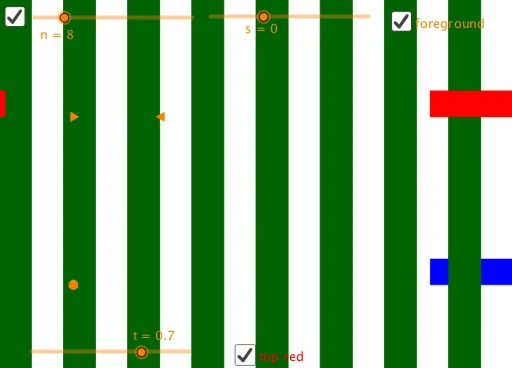
① This example demonstrates a 'footstep illusion' visual phenomenon created by translating and sequentially replicating polygons, simulating alternating footstep patterns. ② Core mathematical concepts include translation transformations, sequence generation, polygon construction, and coordinate geometry involving points and edges, with natural and real number parameters controlling the effect. ③ Construction highlights: Using GeoGebra commands Point, Polygon, Translate, Corner, and Sequence, objects such as A, C, D, B, q2, a, b, i, j, t, n, width are created; the polygon q2 is translated and replicated via Sequence, with Corner for positioning and sliders adjusting step size and count to produce dynamic illusion. ④ Suitable for middle school and above, this is ideal for teaching geometric transformations, exploring visual illusions, or mathematical art, helping students understand the mathematical essence of translation and the role of sequences in graphical generation.
GeoGebra Commands & Parameters
Point(Ray[A, A + (0, -1)]) → CPoint(Ray[C, C + (1, 0)]) → DPoint(Ray[A, A + (1, 0)]) → BPolygon(A, B, B + (0, 1), A + (0, 1)) → q2, a, b, i, jTranslate(q2, ((((t * 2) * n) * width), 0)) → q2'_1Corner(1) → C1Polygon(C1, C1 + (width, 0), C1 + (width, tp - bot), C1 + (0, tp - bot)) → q1, c1, f, g, hTranslate(q2'_1, D - A) → q2'Sequence(Translate[q1, (((((c * s) * t) * 2) * n) + ((2 * i) * width), 0)], i, (-2 * n) - 1, (2 * n)) → L_1Translate(q2'_1, (((-2 * n) * width), 0)) → q3Translate(q2', (((-2 * n) * width), 0)) → q2''Translate(q2t, (((-2 * n) * width), 0)) → q2t'
AI Drawing Prompt Reference
Create a visual illusion pattern made by translating and repeating polygons. Start with a rectangle as the base unit, then replicate it horizontally at regular intervals to form two rows of alternating footstep-like sequences. Adjust the translation step and repetition count to offset the upper and lower rows, creating a dynamic staircase illusion. The final image consists of multiple identical rectangles arranged in two horizontal lines with uniform spacing, where the starting positions of the two rows differ, producing an alternating visual rhythm.
The prompt above was compiled from the original drawing commands and is for reference only.