
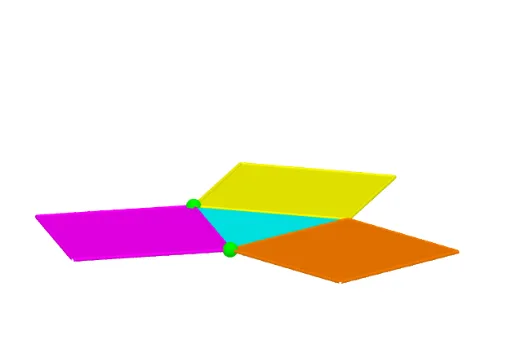
Folding an Octahedron from Three Squares
Loading the math board and drawing, please wait…
① This example demonstrates how to construct a regular octahedron by folding three mutually perpendicular squares, visually illustrating the spatial transformation between a 2D net and a 3D polyhedron. ② Core mathematical concepts include the geometric properties of the octahedron, spatial rotation, symmetry, and the relationship between polygon folding and solid geometry. ③ Construction highlights: using GeoGebra commands such as Polygon, Point, Octahedron, Midpoint, Angle, and Rotate to create three squares, determine vertices, and rotate faces to form the octahedron; key objects include A, B, poly1, f, g, h, C, poly2, and faces like faceABJ, faceAJM, etc. ④ Suitable for upper secondary or early university students learning solid geometry, spatial reasoning, and dynamic geometry software, as well as for classroom demonstrations or exploratory activities.
GeoGebra Commands & Parameters
Polygon(A, B, 3, xOyPlane) → poly1, f, g, h, CPolygon(C, B, 4, xOyPlane) → poly2, i, j, k, l, D, EPolygon(B, A, 4, xOyPlane) → poly3, m, n, p, q, F, GPolygon(A, C, 4, xOyPlane) → poly4, r, s, t, a, H, IPoint(Circle[Midpoint[A, B], (Distance[A, B] * sqrt(3) / 2), Segment[A, B]]) → JOctahedron(A, B, J) → b, K, faceJLM, faceKLM, edgeAJ, edgeAB, edgeBJ, edgeAM, edgeJM, edgeAK, edgeKM, edgeBK, L, edgeBL, edgeKL, edgeJL, edgeLM, M, faceABJ, faceAJM, faceAKM, faceABK, faceBKL, faceBJLMidpoint(edgeKM) → NMidpoint(B, C) → OAngle(A, O, N) → αRotate(poly2, (-c), Segment[B, C]) → poly2'Rotate(poly3, c, Segment[B, A]) → poly3'Rotate(poly4, (-c), Segment[C, A]) → poly4'