
Flips of a Fair Coin
Loading the math board and drawing, please wait…
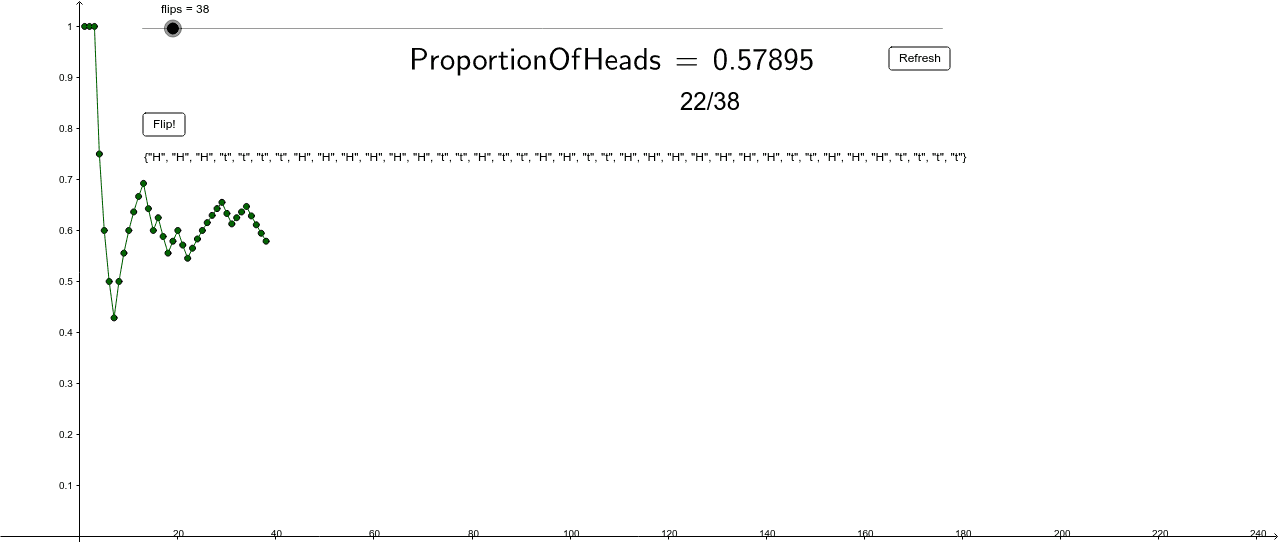
This example demonstrates the process of flipping a fair coin. The core mathematical concept is probability. Using GeoGebra's random number generator and sequence commands, a series of flips can be generated. Suitable for middle school and above students to learn probability statistics.
GeoGebra Commands & Parameters
Random(1, 2) → aSequence(Random[0, 1], k, 1, 1000) → flips_1Sum(flips_1) → bRandom(0, 1) → B2Sequence((n, Sum[flips_1, n] / n), n, 1, flips) → list4LaTeX(ProportionOfHeads, true, true) → text1Sequence(Segment[Element[list4, k], Element[list4, k + 1]], k, 1, flips) → list2Segment((0, 0.5), (1000, 0.5)) → cAppend(list1, Random[1, 2]) → list3Element(flips_1, flips) → lastflip
AI Drawing Prompt Reference
Draw a fair coin flipping process with 1000 flips, calculate the number of heads and the proportion of heads. Draw a line segment from 0 to 1000 to represent the number of flips, with the midpoint at 0.5. Use segments of different colors to connect the points showing the change in proportion of heads over each flip, illustrating the trend of proportion change.
The prompt above was compiled from the original drawing commands and is for reference only.