
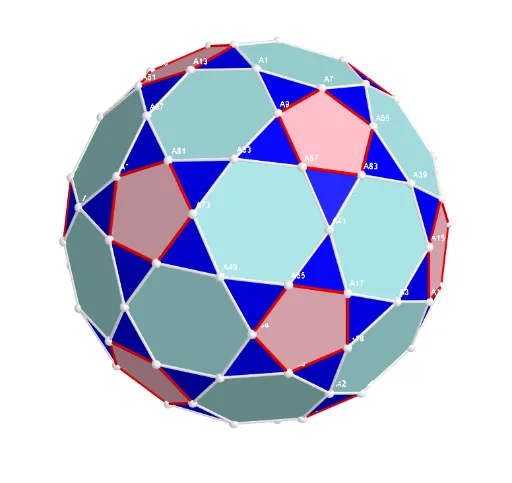
Five-Point Star and Star of David Inscribed in a Rectified Truncated Icosahedron
Loading the math board and drawing, please wait…
This example demonstrates how to inscribe classic star figures—both a five-point star and the Star of David—onto the surface of a rectified truncated icosahedron (a specific polyhedral geometry). It highlights how symmetric polygonal/star patterns can be realized as concrete intersection/connection structures in 3D space. Key math concepts include solid geometry on polyhedral surfaces, sphere/3D geometric point placement, vector-based construction, and controlled geometric transformations (e.g., dilation/“expansion”) that preserve the intended alignment. The GeoGebra construction (from the provided summary) uses Sphere as the 3D geometric basis and establishes point sets (e.g., Points00, parameter n) in space; it employs Sequence and Sum to generate repeated/parameterized elements; it uses UnicodeToLetter, Text, and TableText for labeling and structured parameter display; and it relies on objects such as Segments, vector objects (lVector1/lVector2/lVector3), and other labeled/interactive elements (buttons) to build the star edges from connected segments and derived relations. Suitable for advanced high-school and university-level geometry visualization, especially for lessons or projects on symmetry, polyhedra, and geometric constructions.
GeoGebra Commands & Parameters
UnicodeToLetter(34) → u34Text("" + Um1) → txt_pSum(Flatten[Sequence[Append[Sequence[Element[txt_p, i], i, m01(k), m02(k)], " "], k, 1, 5]]) → txtUm1Zip(Vector[a, a + UnitVector[a]], a, Points00) → lVector1Zip(Vector[a, a + (1.5 * UnitVector[b])], a, Points00, b, Wi_Pc) → lVector2Zip(Vector[a, a + (1.5 * UnitVector[b])], a, Points00, b, Wi_P) → lVector3Sphere((0, 0, 0), 5) → sphTableText(Append["i", 1…n], Append[" \fgcolor{orange}{GM :Δφ_i}, rad", l1w], Append["\fgcolor{magenta}{GC :Δφ_i} , rad", l1cw], "v") → text23rZip(Segment[Element[Points00, y(a)], Element[Points00, z(a)]], a, ll1bb(2)) → ll2Zip(Segment[Element[Points00, y(a)], Element[Points00, z(a)]], a, ll1bb(1)) → ll1Zip(Segment[Element[Points00, y(a)], Element[Points00, z(a)]], a, ll1bb(3)) → ll3Zip(Segment[Element[Points00, y(a)], Element[Points00, z(a)]], a, ll1bb(4)) → ll4Zip(Segment[Element[Points00, y(a)], Element[Points00, z(a)]], a, ll1bb(5)) → ll5Zip(Segment[Element[Points00, y(a)], Element[Points00, z(a)]], a, ll1bb(6)) → ll6Zip(Segment[Element[Points00, y(a)], Element[Points00, z(a)]], a, ll1bb(7)) → ll7Zip(Segment[Element[Points00, y(a)], Element[Points00, z(a)]], a, ll1bb(8)) → ll8Zip(Segment[Element[Points00, y(a)], Element[Points00, z(a)]], a, ll1bb(9)) → ll9Zip(Segment[Element[Points00, y(a)], Element[Points00, z(a)]], a, ll1bb(10)) → ll10Sequence(Polygon[Sequence[Points3D(m5(f, k)), k, 1, Length[m5(1)]]], f, 1, Length[m5]) → poly002Sequence(Polygon[Sequence[Points3D(m6(f, k)), k, 1, Length[m6(1)]]], f, 1, Length[m6]) → poly003Sequence(Polygon[Element[Points3D, Element[Element[mm1, f], 1]], Element[Points3D, Element[Element[mm1, f], 2]], Element[Points3D, Element[Element[mm1, f], 3]]], f, 1, Length[mm1]) → poly001
AI Drawing Prompt Reference
Draw a five-point star and a Star of David inscribed on the surface of a rectified truncated icosahedron using a sphere as the base geometry. Construct point sets through vectors and parameters, connect these points to form the edges of the stars, and highlight the symmetric pattern structure.
The prompt above was compiled from the original drawing commands and is for reference only.