
Finding the Standard Form of an Ellipse
Loading the math board and drawing, please wait…
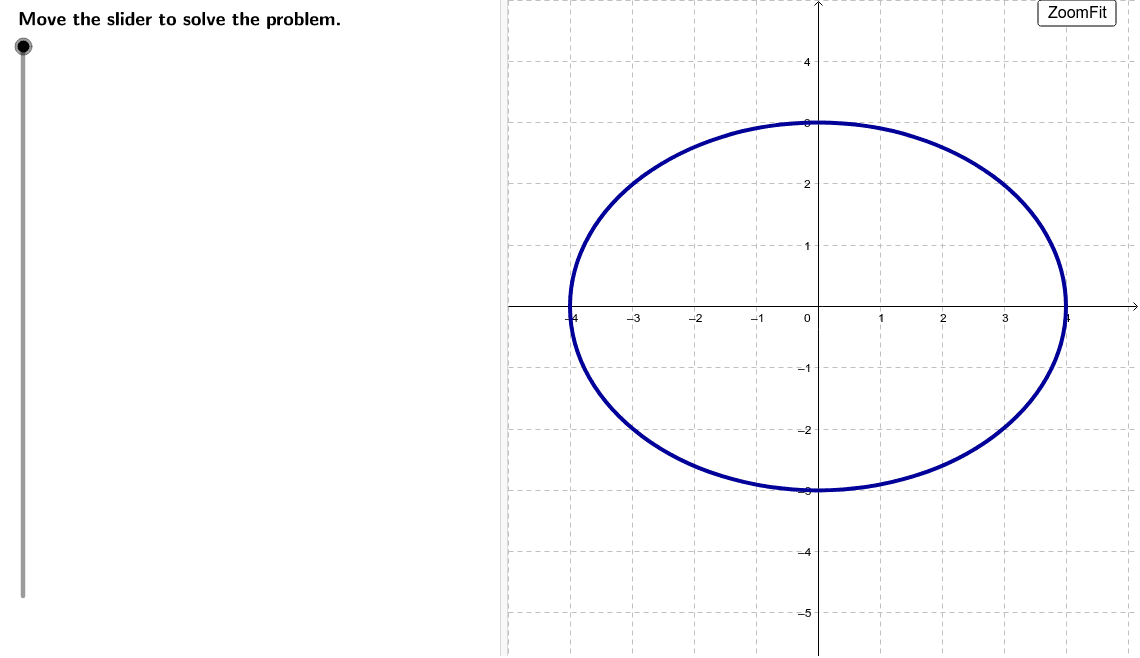
This example demonstrates how to determine and graph the standard form equation of an ellipse. Key math concepts include the definition of an ellipse, standard form equations, and coordinate geometry. Construction highlights the use of GeoGebra commands/objects like LaTeX, Corner, Vector, If, with stepMax, stepper, RandomizationText, and ZoomFit for interactive exploration, suitable for high school coordinate geometry instruction or student investigation.
GeoGebra Commands & Parameters
LaTeX(steps) → counterLaTeX("\text{Move the slider to solve the problem.}") → text0LaTeX("\text{Use the buttons below to return to the original}\cr\text{problem or randomly generate a similar practice}\cr\text{problem.}") → RandomizationTextCorner(1) → ACorner(3) → BVector(Center, MinNeg) → minNegVector(Center, MajNeg) → majNegVector(Center, MajPos) → majPosVector(Center, MinPos) → minPosLaTeX((((((("\text{The minor axis runs } " * minorOrientation) * "\text{ from }") * MinNeg) * "\text{ to }\cr ") * MinPos) * "\text{.}")) → text4If(xden < yden, LaTeX["b^2"], LaTeX["a^2"]) → xdenomIf(x(Center) ≠ 0, LaTeX["(x-x_0)^2"], LaTeX["x^2"]) → xnumIf(y(Center) ≠ 0, LaTeX["(y-y_0)^2"], LaTeX["y^2"]) → ynumIf(xden < yden, LaTeX["a^2"], LaTeX["b^2"]) → ydenomLaTeX((((((((("\frac{" * xnum) * "}{") * xdenom) * "}+\frac{") * ynum) * "}{") * ydenom) * "}=1")) → structureLaTeX((((((((((((("\text{In the graph, the major axis runs " * majorOrientation) * " from }\cr\textcolor{#000099}{") * MajNeg) * "}\text{ to }\textcolor{#000099}{") * MajPos) * "}\text{ and has a length of }\textcolor{#000099}{") * major) * "}\text{.}\cr\text{Therefore, the value of }\textcolor{#000099}{a}\text{ is half of }\textcolor{#000099}{") * major) * "}\text{, or }\textcolor{#000099}{") * semimajor) * "}\text{.}")) → text13LaTeX((((((((((((("\text{In the graph, the minor axis runs " * minorOrientation) * " from }\cr\textcolor{#000099}{") * MinNeg) * "}\text{ to }\textcolor{#000099}{") * MinPos) * "}\text{ and has a length of }\textcolor{#000099}{") * minor) * "}\text{.}\cr\text{Therefore, the value of }\textcolor{#000099}{b}\text{ is half of }\textcolor{#000099}{") * minor) * "}\text{, or }\textcolor{#000099}{") * semiminor) * "}\text{.}")) → text16LaTeX("\text{Since the ellipse is centered at the origin, all the}\cr\text{information about the center is in the form of the}\cr\text{equation used to describe the ellipse.}") → text17LaTeX((((("\text{The point }\textcolor{#000099}{(x_0,y_0)}\text{ in the equation for an ellipse not}\cr\text{centered at the origin is the center of the ellipse.}\cr\text{Therefore, }\textcolor{#000099}{x_0=" * x(Center)) * "}\text{ and }\textcolor{#000099}{y_0=") * y(Center)) * "}\text{.}")) → text17aLaTeX((((((("\text{For this ellipse, the longer axis is the axis that}\cr\text{runs }" * majorOrientation) * "\text{ from }") * MajNeg) * "\text{ to }") * MajPos) * "\text{.}\cr\text{This is the major axis.}")) → text3If(y(Center) ≠ 0, LaTeX[(("(y-" * y(Center)) * ")^2")], LaTeX["y^2"]) → ynumSubIf(x(Center) ≠ 0, LaTeX[(("(x-" * x(Center)) * ")^2")], LaTeX["x^2"]) → xnumSubLaTeX((("\text{Therefore, the correct formula to use is }\cr" * structure) * "\text{, for which }\textcolor{#000099}{a}\text{ is half the}\cr\text{length of the major axis and }\textcolor{#000099}{b}\text{ is half the length}\cr\text{of the minor axis.}")) → text10
AI Drawing Prompt Reference
Draw an ellipse centered at the origin with the major axis along the positive x-axis and the minor axis along the positive y-axis. Adjust the slider to change the shape of the ellipse. Write the standard equation of the ellipse based on the lengths of the major and minor axes. Hint: The length of the major axis is 2a and the length of the minor axis is 2b, where a and b are half the lengths of the major and minor axes, respectively.
The prompt above was compiled from the original drawing commands and is for reference only.