
Finding Six Trigonometric Functions Using Unit Circle
Loading the math board and drawing, please wait…
In collections
UCSS Secondary Math II Unit 5 Lesson 8
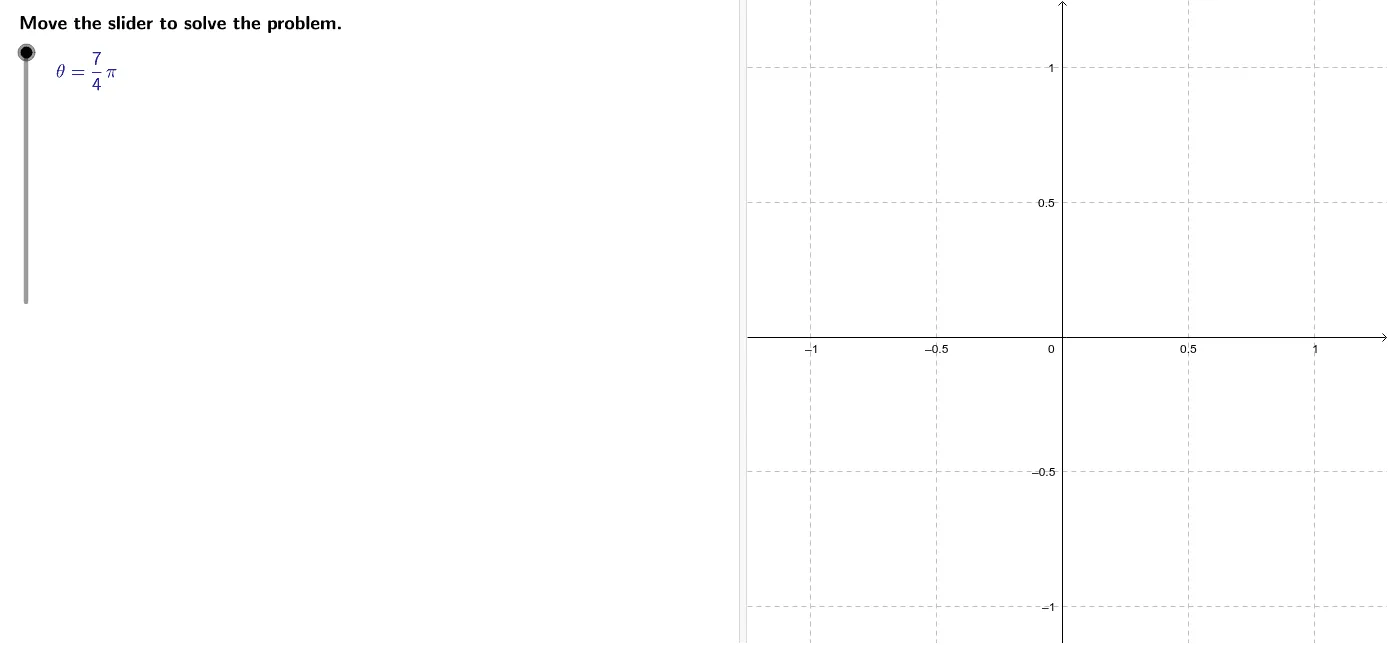
This example demonstrates how to find the values of the six trigonometric functions for the angle θ = 7π/4 using the unit circle. Key math concepts involved include trigonometric functions, unit circle, and angle measurement. GeoGebra commands and objects like LaTeX, Corner, Element, FractionText, Circle, Segment, Angle, If, and Midpoint are used to accurately draw the unit circle and angle, and to calculate the corresponding trigonometric values. Suitable for high school mathematics students to learn and understand the definition and application of trigonometric functions.
GeoGebra Commands & Parameters
LaTeX(steps) → counterLaTeX("\text{Move the slider to solve the problem.}") → text0Corner(1) → ACorner(3) → BElement(fractions, n) → fracFractionText(frac) → fractextCircle((0, 0), 1) → cSegment((0, 0), C) → aSegment((0, 0), (1, 0)) → bAngle(b, a) → αSegment((0, 0), (-1, 0)) → dIf(0 < frac ≤ 0.5, Angle[b, a], If[0.5 < frac ≤ 1, Angle[a, d], If[1 < frac < 1.5, Angle[d, a], Angle[a, b]]]) → βElement(coords, n) → showcoordSegment(C, (x(C), 0)) → eSegment((0, 0), (x(C), 0)) → fMidpoint(e) → DMidpoint(f) → ELaTeX(Element[xvalue, n]) → xlabelLaTeX(Element[yvalue, n]) → ylabel1Midpoint(a) → GSegment((0, 0), F) → gSegment((0, 0), (x(F), 0)) → hSegment((x(F), 0), F) → iLaTeX(Element[yvalue, n]) → ylabel2Midpoint(g) → HMidpoint(h) → IMidpoint(i) → JLaTeX(Element[xvalue, n]) → xlabel2Element(refractions, n) → refracFractionText(refrac) → refractextLaTeX((("\text{Substitute }\textcolor{#000099}{" * fractext) * "\pi}\text{ for }\textcolor{#000099}{\theta}.")) → text5LaTeX((((((("\textcolor{#000099}{\tan\left(" * fractext) * "\pi\right)=\frac{\sin\left(") * fractext) * "\pi\right)}{\cos\left(") * fractext) * "\pi\right)}}")) → text6LaTeX((((((("\textcolor{#000099}{\tan\left(" * fractext) * "\pi\right)=\frac{") * ylabel1) * "}{") * xlabel) * "}}")) → text8LaTeX("\text{Simplify.}") → text9LaTeX("\textcolor{#000099}{\sec(\theta)=\frac{1}{\cos(\theta)}}") → text12LaTeX((((((((("\textcolor{#000099}{\sec\left(" * fractext) * "\pi\right)=\frac{1}{\cos\left(") * fractext) * "\pi\right)}=\frac{1}{") * xlabel) * "}=") * Element[secval, n]) * "}")) → text13LaTeX("\textcolor{#000099}{\csc(\theta)=\frac{1}{\sin(\theta)}}") → text14LaTeX((((((((("\textcolor{#000099}{\csc\left(" * fractext) * "\pi\right)=\frac{1}{\sin\left(") * fractext) * "\pi\right)}=\frac{1}{") * ylabel1) * "}=") * Element[cscval, n]) * "}")) → text15LaTeX("\textcolor{#000099}{\cot(\theta)=\frac{\cos(\theta)}{\sin(\theta)}}") → text16LaTeX((((((((((((("\textcolor{#000099}{\cot\left(" * fractext) * "\pi\right)=\frac{\cos\left(") * fractext) * "\pi\right)}{\sin\left(") * fractext) * "\pi\right)}=\frac{") * xlabel) * "}{") * ylabel1) * "}=") * Element[cotval, n]) * "}")) → text17LaTeX((((("\text{Use the unit circle to find the values of }\textcolor{#000099}{\cos\left(" * fractext) * "\pi\right)}\text{ and }\textcolor{#000099}{\sin\left(") * fractext) * "\pi\right)}.")) → text1LaTeX((((((((((((("\text{The coordinates of the point }\textcolor{#000099}{\theta=" * fractext) * "\pi}\text{ on the unit circle are }\cr\textcolor{#000099}{") * showcoord) * "}\text{ which correspond to the trigonometric ratios }\cr\textcolor{#000099}{\cos\left(") * fractext) * "\pi\right)=") * xlabel) * "}\text{ and }\textcolor{#000099}{\sin\left(") * fractext) * "\pi\right)=") * ylabel1) * "}.")) → text3LaTeX((("\text{Use the ratio identity }\textcolor{#000099}{\tan(\theta)=\frac{\sin(\theta)}{\cos(\theta)}}\text{ to find the value of }\textcolor{#000099}{\tan\left(" * fractext) * "\pi\right)}.")) → text4LaTeX((((((((("\text{Substitute }\textcolor{#000099}{" * xlabel) * "}\text{ for }\textcolor{#000099}{\cos\left(") * fractext) * "\pi\right)}\text{ and }\cr\textcolor{#000099}{") * ylabel1) * "}\text{ for }\textcolor{#000099}{\sin\left(") * fractext) * "\pi\right)}.")) → text7LaTeX("\text{Use the reciprocal identities to find the remaining trigonometric values.}") → text11LaTeX("\text{Use the buttons below to return to the original problem or}\cr\text{randomly generate a similar practice problem.}") → RandomizationTextLaTeX((("\textcolor{#000099}{\theta=" * fractext) * "\pi}")) → ProblemLaTeX((((("\textcolor{#000099}{\tan\left(" * fractext) * "\pi\right)=") * Element[tanval, n]) * "}")) → text10If(1 ≤ n ≤ 5, LaTeX[(((("\text{Since }\textcolor{#000099}{0 \le " * fractext) * "\pi \le \frac{\pi}{2}}\text{ (or, in degrees, }\textcolor{#000099}{0\le ") * degrees) * "^{\circ} \le 90^{\circ}}\text{),}\cr\text{the angle is in the first quadrant. The angle is its own}\cr\text{reference angle.}")], If[6 ≤ n ≤ 9, LaTeX[(((((("\text{Since }\textcolor{#000099}{\frac{\pi}{2} < " * fractext) * "\pi \le \pi }\text{ (or, in degrees, } \textcolor{#000099}{ 90^{\circ} < ") * degrees) * "^{\circ} \le 180^{\circ}}\text{),}\cr\text{the angle is in the second quadrant. The reference angle is }\textcolor{#006633}{") * refractext) * "\pi}\cr\text{measured up from the negative }\textit{x}\text{-axis as shown.}")], If[10 ≤ n ≤ 13, LaTeX[(((((("\text{Since }\textcolor{#000099}{ \pi < " * fractext) * "\pi \le \frac{3\pi}{2} }\text{ (or, in degrees, } \textcolor{#000099}{ 180^{\circ} < ") * degrees) * "^{\circ} \le 270^{\circ}}\text{),}\cr\text{the angle is in the third quadrant. The reference angle is }\textcolor{#006633}{") * refractext) * "\pi}\cr\text{measured down from the negative }\textit{x}\text{-axis as shown.}")], LaTeX[(((((("\text{Since }\textcolor{#000099}{ \frac{3\pi}{2} < " * fractext) * "\pi \le 2\pi }\text{ (or, in degrees, }\textcolor{#000099}{ 270^{\circ} < ") * degrees) * "^{\circ} \le 360^{\circ}}\text{),}\cr\text{the angle is in the fourth quadrant. The reference angle is }\textcolor{#006633}{") * refractext) * "\pi}\cr\text{measured down from the positive }\textit{x}\text{-axis as shown.}")]]]) → text2
AI Drawing Prompt Reference
Draw a unit circle and label the angle θ = 7π/4, showing the values of the six trigonometric functions for this angle. First, draw the unit circle and the angle θ, then find the intersection point of the angle's terminal side with the unit circle and display its coordinates. Next, calculate and display the values of cosine, sine, tangent, and other trigonometric functions based on the coordinates, using different colors and labels. Finally, provide text explanations on how to use the unit circle and the definitions of trigonometric functions to solve these values.
The prompt above was compiled from the original drawing commands and is for reference only.