
Finding Derivatives of Trigonometric Functions
Loading the math board and drawing, please wait…
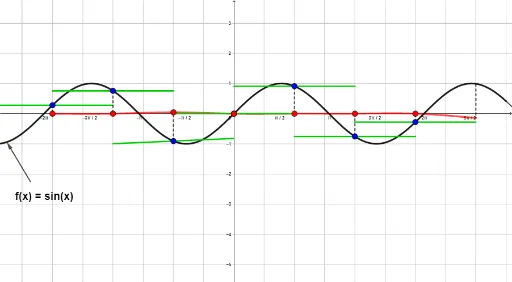
This example demonstrates how to use GeoGebra to plot trigonometric functions and their derivatives, covering core concepts like trigonometric functions, derivatives, and function graph transformations. It utilizes commands and objects such as Point, Derivative, Circle, Intersect, Segment, Textfield, Polynomial, Spline, Tangent, and Vector. Ideal for high school mathematics teaching and learning introductory calculus concepts.
GeoGebra Commands & Parameters
Point(l) → NPoint(g) → JDerivative(f) → f'Point(h) → KPoint(i) → LPoint(p) → QPoint(n) → PPoint(m) → OPoint(q) → RCircle(E, 2) → cIntersect(c, r) → S, TSegment(S, T) → sCircle(A, 2) → dIntersect(d, t) → U, VSegment(U, V) → eCircle(F, 2) → c_1Intersect(c_1, f_1) → W, ZSegment(W, Z) → g_1Circle(B, 2) → d_1Intersect(d_1, h_1) → A_1, B_1Segment(A_1, B_1) → i_1Circle(G, 2) → e_1Intersect(e_1, j_1) → C_1, D_1Segment(C_1, D_1) → k_1Circle(C, 2) → p_1Intersect(p_1, l_1) → E_1, F_1Segment(E_1, F_1) → m_1Circle(H, 2) → q_1Intersect(q_1, n_1) → G_1, H_1Segment(G_1, H_1) → r_1Circle(D, 2) → s_1Intersect(s_1, t_1) → I_1, J_1Segment(I_1, J_1) → a_1Circle(I, 2) → c_2Intersect(c_2, b_1) → K_1, L_1Segment(K_1, L_1) → f_2Textfield(f) → ChampTexte1Polynomial(l1) → g_2Spline(l1, 3) → uSegment(E, N) → h_2Segment(A, J) → i_2Segment(F, O) → j_2Segment(B, K) → k_2Segment(P, G) → l_2Segment(L, C) → m_2Segment(H, Q) → n_2Segment(D, M) → q_2Tangent(N_1, p_2) → r_2Circle(N_1, 2) → d_2Intersect(d_2, r_2) → O_1, P_1Segment(P_1, O_1) → s_2Segment(M_1, N_1) → t_2Intersect(f, p_2, (-7.509791604489711, -0.9413490732161692)) → R_1Vector(Q_1, R_1) → vPoint(f') → S_1Vector(T_1, S_1) → w