
Feuerbach Theorem and Feuerbach Point
Loading the math board and drawing, please wait…
In collections
A Tour of Triangle Geometry
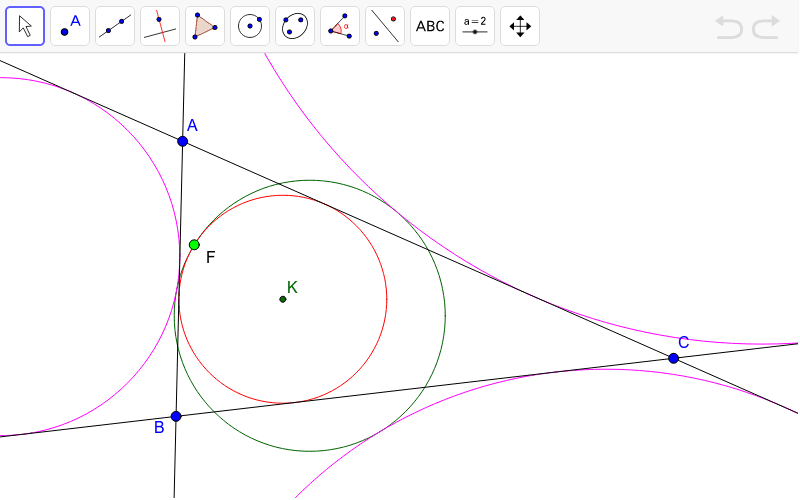
This example illustrates the Feuerbach Theorem, which states that the nine-point circle is internally tangent to the incircle and externally tangent to the three excircles. Using GeoGebra commands such as Line, OrthogonalLine, LineBisector, etc., the nine-point circle, incircle, and excircles can be constructed and their relationships observed. Suitable for students at the junior high school level and above to learn about geometric constructions and properties of circles.
GeoGebra Commands & Parameters
Line(A, B) → mLine(C, A) → nLine(B, C) → qOrthogonalLine(A, q) → aOrthogonalLine(B, n) → bOrthogonalLine(C, m) → cLineBisector(B, C) → dLineBisector(C, A) → eLineBisector(A, B) → fIntersect(q, a) → DIntersect(n, e) → EIntersect(n, b) → F_1Intersect(m, c) → G_1Intersect(m, f) → IIntersect(q, d) → JCircle(G_1, D, E) → kSegment(A, J) → iSegment(B, E) → jSegment(I, C) → lIntersect(i, j) → GAngularBisector(n, m) → g, hAngularBisector(q, m) → p, rAngularBisector(n, q) → s, tIntersect(g, p) → HIntersect(h, r) → KIntersect(h, p) → LIntersect(g, r) → MOrthogonalLine(M, q) → a_1OrthogonalLine(L, q) → b_1OrthogonalLine(H, n) → c_1Intersect(n, c_1) → NCircle(H, N) → d_1Intersect(q, a_1) → OCircle(M, O) → e_1Intersect(q, b_1) → PCircle(L, P) → f_1OrthogonalLine(K, q) → g_1Intersect(q, g_1) → QCircle(K, Q) → h_1Intersect(h_1, k) → F, , ,