
Feuerbach Theorem and Feuerbach Point Part 2
Loading the math board and drawing, please wait…
In collections
A Tour of Triangle Geometry
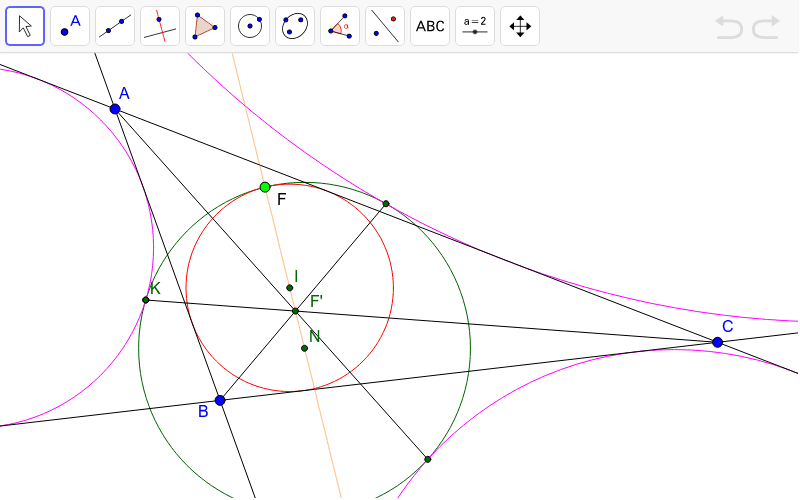
This example demonstrates the concurrency of lines from the points of tangency of the nine-point circle and excircles to the opposite vertices (Feuerbach point F'). Key mathematical concepts include triangles, circles, and geometric construction. GeoGebra commands used include Line, OrthogonalLine, LineBisector, Intersect, Circle, Segment, AngularBisector, Center. Suitable for high school geometry learners and math enthusiasts.
GeoGebra Commands & Parameters
Line(A, B) → mLine(C, A) → nLine(B, C) → qOrthogonalLine(A, q) → aOrthogonalLine(B, n) → bOrthogonalLine(C, m) → cLineBisector(B, C) → dLineBisector(C, A) → eLineBisector(A, B) → fIntersect(q, a) → DIntersect(n, e) → EIntersect(n, b) → F_1Intersect(m, c) → G_1Intersect(m, f) → I_1Intersect(q, d) → JCircle(G_1, D, E) → kSegment(A, J) → iSegment(B, E) → jSegment(I_1, C) → lIntersect(i, j) → GAngularBisector(n, m) → g, hAngularBisector(q, m) → p, rAngularBisector(n, q) → s, tIntersect(g, p) → HIntersect(h, r) → IIntersect(h, p) → LIntersect(g, r) → MOrthogonalLine(M, q) → a_1OrthogonalLine(L, q) → b_1OrthogonalLine(H, n) → c_1Intersect(n, c_1) → N_1Circle(H, N_1) → d_1Intersect(q, a_1) → OCircle(M, O) → e_1Intersect(q, b_1) → PCircle(L, P) → f_1OrthogonalLine(I, q) → g_1Intersect(q, g_1) → QCircle(I, Q) → h_1Intersect(h_1, k) → F, , ,Intersect(k, e_1, 1) → RIntersect(k, f_1, 1) → SIntersect(d_1, k) → T, K, ,Center(k) → NSegment(B, R) → i_1Segment(T, C) → j_1Segment(A, S) → k_1Line(I, N) → l_1Intersect(l_1, i_1) → F'
AI Drawing Prompt Reference
Draw a triangle ABC, then construct the perpendicular bisectors of BC, CA, and AB, and the angle bisectors of the exterior angles at A, B, and C, finding their intersections D, E, F₁, G₁, I₁, and J. Draw a circle k with G₁, D, and E as points. Connect A to J, B to E, and I₁ to C, finding their intersection G. Construct the angle bisectors of n, m, and q, finding their intersections H, I, L, and M. Draw the perpendiculars from M to q (a₁), L to q (b₁), and H to n (c₁), finding their intersection N₁. Draw a circle d₁ with H and N₁ as points. Continue with other perpendiculars and circles, eventually finding F, R, S, T, and K. Draw a circle N with K as the center. Connect B to R, T to C, and A to S. Finally, draw the line I to N.
The prompt above was compiled from the original drawing commands and is for reference only.