
FCHS Parallelogram Investigation
Loading the math board and drawing, please wait…
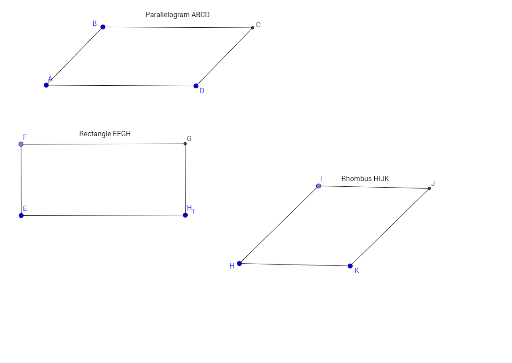
This example demonstrates the fundamental properties of a parallelogram, including the relationships of its diagonals and midpoints. Core mathematical concepts covered are the definition of a parallelogram, opposite sides being parallel and equal, diagonals bisecting each other, and vector parallelism. Construction highlights: the GeoGebra commands Segment, Line, Intersect, OrthogonalLine, Point, and Circle are used to create vertices A, B, C, D, edges, diagonals, perpendicular lines, circles, and text labels. It is suitable for middle‑school geometry instruction, high‑school geometry review, and geometric construction practice, serving as a classroom demonstration or independent exploration resource.
GeoGebra Commands & Parameters
Segment(A, D) → fSegment(A, B) → gLine(B, f) → hLine(D, g) → iIntersect(h, i) → CSegment(B, C) → jSegment(D, C) → kSegment(E, H_1) → lOrthogonalLine(E, l) → mPoint(m) → FSegment(F, E) → nLine(F, l) → pLine(H_1, n) → qIntersect(p, q) → GSegment(F, G) → rSegment(H_1, G) → sSegment(H, K) → tCircle(H, t) → cPoint(c) → ISegment(H, I) → aLine(I, t) → bLine(K, a) → dIntersect(b, d) → JSegment(J, I) → eSegment(J, K) → f_1