
Parallelogram Geometry Task: Incircle and Trigonometric Functions
Loading the math board and drawing, please wait…
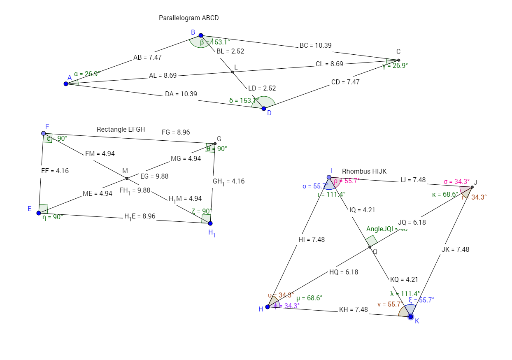
This example demonstrates a comprehensive geometric construction involving a parallelogram, an incircle, trigonometric functions, and linear equations. The core mathematical concepts include properties of parallelograms, incircles and tangents, angle measurement, distance calculation, and trigonometric relationships. Construction highlights: using GeoGebra commands such as Segment, Line, Intersect, OrthogonalLine, Point, Circle, Angle, and Distance, the construction builds multiple points (A, D, B, C, E, F, G, H, I, J, K, etc.), segments, lines, perpendiculars, circles, and angle objects (α, β, γ, δ, ε), with text objects (text1, text2, text3) for labeling. This task is suitable for high school or early college students to deepen their understanding of the connection between geometric figures and trigonometric functions, as well as construction and measurement techniques in dynamic geometry software.
GeoGebra Commands & Parameters
Segment(A, D) → fSegment(A, B) → gLine(B, f) → hLine(D, g) → iIntersect(h, i) → CSegment(B, C) → jSegment(D, C) → kSegment(E, H_1) → lOrthogonalLine(E, l) → mPoint(m) → FSegment(F, E) → nLine(F, l) → pLine(H_1, n) → qIntersect(p, q) → GSegment(F, G) → rSegment(H_1, G) → sSegment(H, K) → tCircle(H, t) → cPoint(c) → ISegment(H, I) → aLine(I, t) → bLine(K, a) → dIntersect(b, d) → JSegment(J, I) → eSegment(J, K) → f_1Angle(D, A, B) → αAngle(A, B, C) → βAngle(B, C, D) → γAngle(C, D, A) → δAngle(E, F, G) → εAngle(G, H_1, E) → ζAngle(H_1, E, F) → ηAngle(F, G, H_1) → θAngle(H, I, J) → ιAngle(I, J, K) → κAngle(J, K, H) → λAngle(K, H, I) → μDistance(A, B) → distanceABDistance(B, C) → distanceBCDistance(C, D) → distanceCDDistance(D, A) → distanceDADistance(F, G) → distanceFGDistance(G, H_1) → distanceGH1Distance(H_1, E) → distanceH1EDistance(E, F) → distanceEFDistance(I, J) → distanceIJDistance(J, K) → distanceJKDistance(K, H) → distanceKHDistance(H, I) → distanceHISegment(A, C) → g_1Segment(B, D) → h_1Segment(F, H_1) → i_1Segment(G, E) → j_1Segment(H, J) → k_1Segment(K, I) → l_1Intersect(g_1, h_1) → LIntersect(j_1, i_1) → MIntersect(l_1, k_1) → QDistance(A, L) → distanceALDistance(B, L) → distanceBLDistance(L, D) → distanceLDDistance(C, L) → distanceCLDistance(F, M) → distanceFMDistance(M, G) → distanceMGDistance(H_1, M) → distanceH1MDistance(M, E) → distanceMEDistance(H, Q) → distanceHNDistance(I, Q) → distanceINDistance(J, Q) → distanceJNDistance(K, Q) → distanceKNDistance(E, G) → distanceEGDistance(F, H_1) → distanceFH1Angle(J, Q, I) → AngleJQIAngle(I, K, H) → νAngle(J, K, I) → ξAngle(H, I, Q) → οAngle(K, I, J) → ρAngle(I, J, H) → σAngle(H, J, K) → τAngle(J, H, I) → υAngle(K, H, J) → ϕ