
Exterior Angles of Polygons Demo
Loading the math board and drawing, please wait…
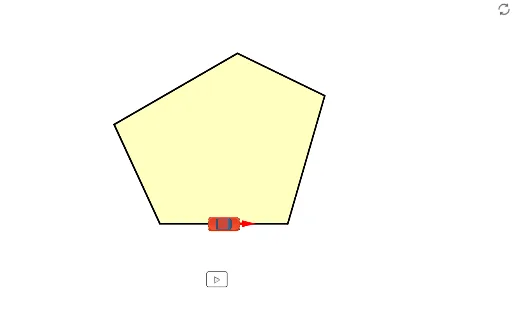
This example demonstrates the properties of exterior angles in polygons by metaphorically simulating a car turning at each vertex as it travels along the sides. It covers core concepts like exterior angles, sum of interior angles, and geometric transformations. Key GeoGebra commands used include Rotate, Polygon, Vector, and Angle for dynamic visualization. Suitable for middle school and above, helping students grasp spatial geometry and the exterior angle theorem.
GeoGebra Commands & Parameters
Rotate((x(P1) + (x(A) - x(E)) / Distance[E, A], y(P1) + (y(A) - y(E)) / Distance[E, A]), (Min[Max[t - 1, 0], 1] * (180° - Angle[B, A, E])), P1) → P1'Rotate((x(P2) + (x(B) - x(A)) / Distance[A, B], y(P2) + (y(B) - y(A)) / Distance[A, B]), (Min[Max[t - 3, 0], 1] * (180° - Angle[C, B, A])), P2) → P2'Rotate((x(P3) + (x(C) - x(B)) / Distance[B, C], y(P3) + (y(C) - y(B)) / Distance[B, C]), (Min[Max[t - 5, 0], 1] * (180° - Angle[D, C, B])), P3) → P3'Rotate((x(P4) + (x(D) - x(C)) / Distance[C, D], y(P4) + (y(D) - y(C)) / Distance[C, D]), (Min[Max[t - 7, 0], 1] * (180° - Angle[E, D, C])), P4) → P4'Rotate((x(P5) + (x(E) - x(D)) / Distance[E, D], y(P5) + (y(E) - y(D)) / Distance[E, D]), (Min[Max[t - 9, 0], 1] * (180° - Angle[A, E, D])), P5) → P5'Polygon(E, A, B, C, D) → poly1, a_1, b_1, c_1, d_1, e_1If(t ≤ 2, P1, If[t ≤ 4, P2, If[t ≤ 6, P3, If[t ≤ 8, P4, If[t ≤ 10, P5, P6]]]]) → PIf(t ≤ 2, P1', If[t ≤ 4, P2', If[t ≤ 6, P3', If[t ≤ 8, P4', If[t ≤ 10, P5', P6']]]]) → P'Vector(P, P') → uAngle(P1', P1, (x(P1) + (x(A) - x(E)) / Distance[E, A], y(P1) + (y(A) - y(E)) / Distance[E, A])) → αAngle(P2', P2, (x(P2) + (x(B) - x(A)) / Distance[A, B], y(P2) + (y(B) - y(A)) / Distance[A, B])) → βAngle(P3', P3, (x(P3) + (x(C) - x(B)) / Distance[B, C], y(P3) + (y(C) - y(B)) / Distance[B, C])) → γAngle(P4', P4, (x(P4) + (x(D) - x(C)) / Distance[C, D], y(P4) + (y(D) - y(C)) / Distance[C, D])) → δAngle(P5', P5, (x(P5) + (x(E) - x(D)) / Distance[E, D], y(P5) + (y(E) - y(D)) / Distance[E, D])) → εOrthogonalLine(P, u) → fPoint(f) → FMidpoint(F, P') → GVector(G, P) → vTranslate(P, v) → P'_1Translate(P', v) → P''Midpoint(a_1) → OSegment(A, A + ((1.5 * r) * UnitVector[Segment[E, A]])) → gSegment(B, B + ((1.5 * r) * UnitVector[Segment[A, B]])) → hSegment(C, C + ((1.5 * r) * UnitVector[Segment[B, C]])) → iSegment(D, D + ((1.5 * r) * UnitVector[Segment[C, D]])) → jSegment(E, E + ((1.5 * r) * UnitVector[Segment[D, E]])) → kAngle((x(A) + (x(A) - x(E)) / Distance[E, A], y(A) + (y(A) - y(E)) / Distance[E, A]), A, B) → aAngle((x(B) + (x(B) - x(A)) / Distance[A, B], y(B) + (y(B) - y(A)) / Distance[A, B]), B, C) → bAngle((x(C) + (x(C) - x(B)) / Distance[B, C], y(C) + (y(C) - y(B)) / Distance[B, C]), C, D) → cAngle((x(D) + (x(D) - x(C)) / Distance[C, D], y(D) + (y(D) - y(C)) / Distance[C, D]), D, E) → dAngle((x(E) + (x(E) - x(D)) / Distance[D, E], y(E) + (y(E) - y(D)) / Distance[D, E]), E, A) → eCircleSector(C, If[c ≤ 180°, C + (r * UnitVector[Segment[B, C]]), C + (r * UnitVector[Segment[C, D]])], If[c ≤ 180°, D, C + (r * UnitVector[Segment[B, C]])]) → c'CircleSector(A, If[a ≤ 180°, A + (r * UnitVector[Segment[E, A]]), A + (r * UnitVector[Segment[A, B]])], If[a ≤ 180°, B, A + (r * UnitVector[Segment[E, A]])]) → a'CircleSector(B, If[b ≤ 180°, B + (r * UnitVector[Segment[A, B]]), B + (r * UnitVector[Segment[B, C]])], If[b ≤ 180°, C, B + (r * UnitVector[Segment[A, B]])]) → b'CircleSector(D, If[d ≤ 180°, D + (r * UnitVector[Segment[C, D]]), D + (r * UnitVector[Segment[D, E]])], If[d ≤ 180°, E, D + (r * UnitVector[Segment[C, D]])]) → d'CircleSector(E, If[e ≤ 180°, E + (r * UnitVector[Segment[D, E]]), E + (r * UnitVector[Segment[E, A]])], If[e ≤ 180°, A, E + (r * UnitVector[Segment[D, E]])]) → e'Corner(1) → ICorner(3) → JCorner(5) → pixelnosIf(s ≤ 0.5, (-8 * (1 - (2 * s))) - (80 * s), (-40 * (1 - (2 * (s - 0.5)))) - (1120 * (s - 0.5))) → xminIf(s ≤ 0.5, (-5 * (1 - (2 * s))) - (50 * s), (-25 * (1 - (2 * (s - 0.5)))) - (700 * (s - 0.5))) → yminIf(a + b + c + d + e ≟ 360°, true, false) → convex
AI Drawing Prompt Reference
Draw a polygon with simulated car turns at each vertex to demonstrate the properties of exterior angles. Rotate vectors at the vertices to form dynamic exterior angles, labeling the relationships between interior and exterior angles. Connect the vertices with lines to form the polygon, and draw sectors corresponding to the exterior angles to show they sum to 360 degrees. Add auxiliary lines and midpoints to help understand the exterior angle theorem and geometric transformations.
The prompt above was compiled from the original drawing commands and is for reference only.