
Exterior Angles of Polygons by Tim Brzezinski
Loading the math board and drawing, please wait…
In collections
Congruence (CO) Cluster
Polygons & Angles
Polygons & Angles ( s n attar)
Polygons & Angles
Year 9 Mathematics
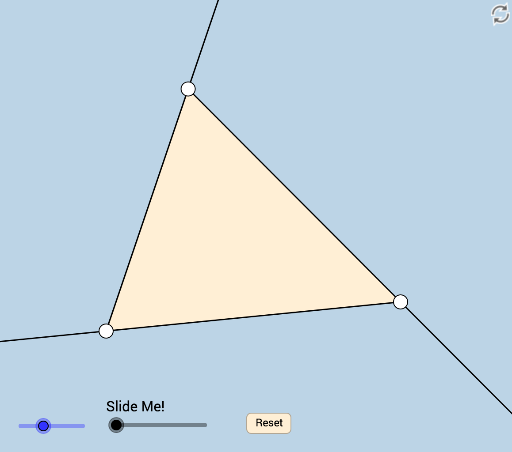
This example demonstrates the exterior angles of triangles, quadrilaterals, and pentagons, allowing quick discovery through dynamic and modifiable activities. It covers core concepts like the sum of exterior angles and the relationship between interior and exterior angles. Constructed using commands such as Rotate, Angle, Ray, Point, Segment, Min, Circle, Intersect, CircleSector, Polygon, Dilate, Vector, and Translate, it is suitable for middle school and higher education to explore polygon properties interactively.
GeoGebra Commands & Parameters
Rotate(A, (b * π / 180), B) → A'Angle(A, B, A') → αRay(B, A) → fRay(B, A') → gPoint(g) → CSegment(C, A) → hSegment(B, C) → iSegment(B, A) → jMin({j, i, h}) → cRay(C, A) → kRay(A, B) → lCircle(B, (0.2 * c)) → dCircle(A, (0.2 * c)) → eCircle(C, (0.2 * c)) → pIntersect(e, l, 1) → DIntersect(e, k, 2) → EIntersect(d, l, 2) → FIntersect(g, i) → GIntersect(g, i) → HIntersect(d, g, 1) → IIntersect(p, k) → J,Intersect(p, g) → K, LCircleSector(B, I, F) → qCircleSector(C, J, L) → rCircleSector(A, D, E) → sPolygon(B, A, C) → poly1, c_1, b_1, a_1Dilate(A, If[1 < a ≤ 2, 2 - a, 0], B) → A'_1Vector(A, A'_1) → uDilate(B, If[3 < a ≤ 4, 4 - a, 0], C) → B'Vector(B, B') → vTranslate(q, v) → q'Translate(s, u) → s'Translate(s', v) → s''Translate(q, v) → q'_1CircleArc(A, D, E) → tCircleArc(B, I, F) → d_1Angle(B, A, E) → βAngle(C, B, F) → γAngle(A, C, L) → δRotate(E, If[0 < a ≤ 1, (-((a * β))), (-β)], A) → E'CircleSector(A, E', E) → e_1Translate(e_1, u) → f_1Rotate(F, If[2 < a ≤ 3, ((-(a - 2)) * γ), (-γ)], B) → F'CircleSector(B, F', F) → g_1Translate(g_1, v) → h_1Translate(f_1, v) → k_1Rotate(L, If[4 < a ≤ 5, ((-(a - 4)) * δ), (-δ)], C) → L'CircleSector(C, L', L) → p_1
AI Drawing Prompt Reference
Create an interactive diagram showing exterior angles of polygons. Start with a triangle where one vertex can slide along a ray to change its shape. At each vertex, draw an arc representing the exterior angle and fill it with a colored sector. Show translation arrows from vertices to illustrate how exterior angles can be rearranged. Use a slider to switch between triangle, quadrilateral, and pentagon, dynamically demonstrating that the sum of exterior angles is always 360 degrees. Include clear vertex labels, angle arcs, and auxiliary rays for educational clarity.
The prompt above was compiled from the original drawing commands and is for reference only.