
Exterior Angle Sum Theorem
Loading the math board and drawing, please wait…
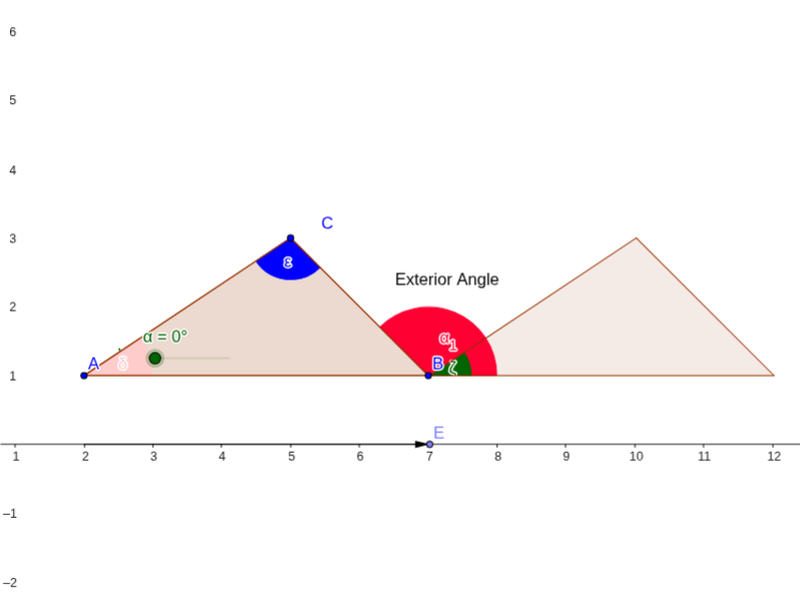
This example demonstrates the relationship between exterior and interior angles in a triangle. The Exterior Angle Sum Theorem states that an exterior angle equals the sum of the two non-adjacent interior angles. Key mathematical concepts include geometry, triangle angles, and construction techniques. Construction involves GeoGebra commands such as Polygon, Point, Angle, and Translate to create the triangle and mark the exterior angles. Suitable for middle or high school mathematics to understand geometric theorems and angle measurement.
GeoGebra Commands & Parameters
Polygon(A, B, C) → poly1, c, a, bPoint(xAxis) → DPoint(xAxis) → EVector(D, E) → uTranslate(A, u) → A'Translate(B, u) → B'Translate(C, u) → C'Polygon(A', B', C') → poly1', c', a', b'Angle(C, B, F) → α_1Angle(A, C, B) → βAngle(C, A, B) → γMidpoint(a) → GRotate(A, -α, G) → A'_1Rotate(B, -α, G) → B'_1Rotate(C, -α, G) → C'_1Polygon(A'_1, B'_1, C'_1) → poly1'_1, c'_1, a'_1, b'_1Angle(B'_1, A'_1, C'_1) → δAngle(A'_1, C'_1, B'_1) → εAngle(C', A', B') → ζ