
Exterior Angle Sum Theorem by janetvmiller
Loading the math board and drawing, please wait…
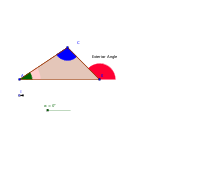
This example demonstrates the exterior angle sum theorem. Key mathematical concepts include the relationship between the exterior and interior angles of a triangle. Using GeoGebra commands such as Polygon, Point, Vector, Translate, etc., it dynamically shows the relationship between the exterior and interior angles of a triangle. Suitable for middle school and above students to learn geometry.
GeoGebra Commands & Parameters
Polygon(A, B, C) → poly1, c, a, bPoint(xAxis) → DPoint(xAxis) → EVector(D, E) → uTranslate(A, u) → A'Translate(B, u) → B'Translate(C, u) → C'Polygon(A', B', C') → poly1', c', a', b'Angle(C, B, F) → α_1Angle(A, C, B) → βAngle(C, A, B) → γMidpoint(a) → GRotate(A, -α, G) → A'_1Rotate(B, -α, G) → B'_1Rotate(C, -α, G) → C'_1Polygon(A'_1, B'_1, C'_1) → poly1'_1, c'_1, a'_1, b'_1Angle(B'_1, A'_1, C'_1) → δAngle(A'_1, C'_1, B'_1) → εAngle(C', A', B') → ζ
AI Drawing Prompt Reference
Draw a triangle and demonstrate the exterior angle sum theorem. First, create a triangle and then draw an exterior angle on one of its sides, labeling an interior angle and its corresponding exterior angle. Next, translate the triangle along the exterior angle side to form a new triangle, comparing the angle relationships between the original and new triangles. Finally, use rotation to show the mathematical relationship between the interior and exterior angles, highlighting the changes in angles after rotation.
The prompt above was compiled from the original drawing commands and is for reference only.