
Exterior Angle of a Triangle – Dynamic Demonstration
Loading the math board and drawing, please wait…
In collections
Y7 Polygons
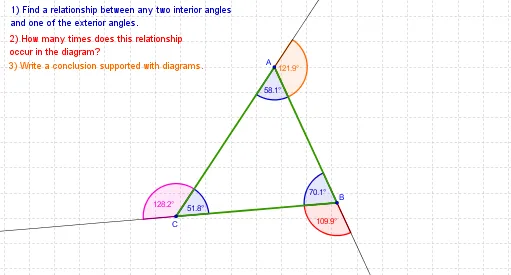
① This GeoGebra example dynamically demonstrates the exterior angle theorem of a triangle, showing that an exterior angle equals the sum of the two non-adjacent interior angles. ② Core mathematical concepts include the definition of interior and exterior angles, angle measurement, and the relationship between angles in a triangle. ③ Construction details: The triangle poly1 is created using the Polygon command with vertices A, B, C; a ray is drawn from vertex C extending side BC to form the exterior angle; the Angle command marks interior angles α, β, γ and exterior angles δ, ε, ζ, with text objects text1, text2, text3 displaying their measures for real-time comparison. ④ Suitable for middle school geometry lessons, teacher demonstrations, or student self-exploration to visually verify the theorem and deepen understanding of angle relationships.
GeoGebra Commands & Parameters
Polygon(A, B, C) → poly1, c, a, bRay(B, C) → dRay(C, A) → eRay(A, B) → fAngle(e, d) → αAngle(d, f) → βAngle(f, e) → γAngle(poly1) → δ, ε, ζ
AI Drawing Prompt Reference
Draw a triangle with three vertices. From one vertex, extend a ray outward along one side to create an exterior angle at that vertex. Mark the three interior angles with arcs, and also mark the exterior angle formed by the ray and the adjacent side. Display the degree measure next to each angle so the relationship is visible: the exterior angle equals the sum of the two non-adjacent interior angles. The figure should clearly show the triangle, the exterior ray, angle arcs, and numeric labels, suitable for classroom demonstration or student exploration.
The prompt above was compiled from the original drawing commands and is for reference only.