
Exponents: Division Rule with Coefficients Demo
Loading the math board and drawing, please wait…
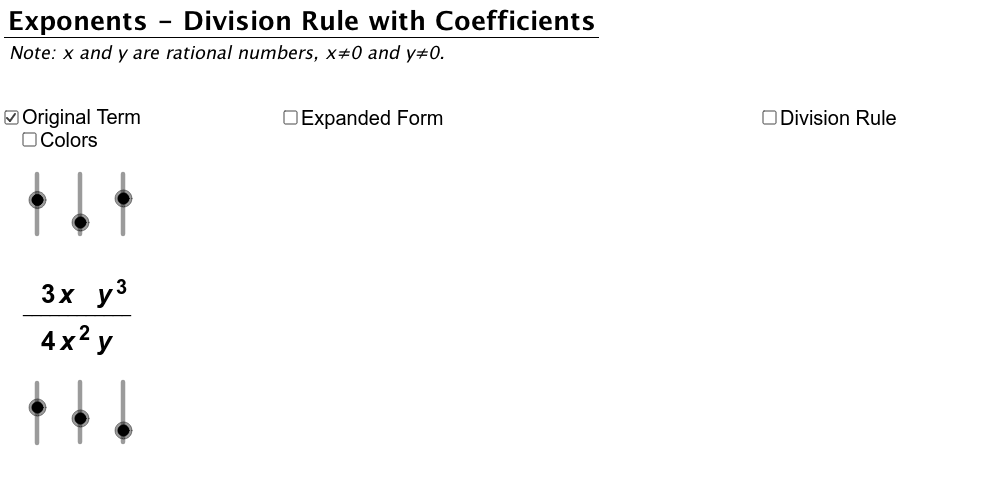
This example demonstrates the exponent division rule applied to algebraic expressions with coefficients. It involves core math concepts like exponent rules, fractional representation, and geometric transformations. Constructed using GeoGebra commands and objects such as Text, If, Sequence, Translate, Polygon, FractionText, and Segment, it visually illustrates the rule. Suitable for high school mathematics education to help students understand and apply the exponent division rule.
GeoGebra Commands & Parameters
Text("y") → text4Text("y") → text6Text("x") → text5Text(expX1 + "") → text8Text(expX2 + "") → text9Text(expY1 + "") → text10Text(expY2 + "") → text11If(color, 255.0, 0.0) → factorColor255If(color, 153.0, 0.0) → factorColor153Text("x") → text3If(expX1 - expX2 ≟ 0.0 ∧ expY1 - expY2 ≟ 0.0, 1.0, 0.0) → zerosSequence(Translate[xtop, Vector[(0.0, 0.0), (-(0.75) * i, 0.0)]], i, 0.0, expX1 - 1.0) → ExpandXtopSequence(Translate[ytop, Vector[(0.0, 0.0), (0.75 * i, 0.0)]], i, 0.0, expY1 - 1.0) → ExpandYtopSequence(Translate[xtop, Vector[(0.0, 0.0), (-(0.75) * i, -(1.2))]], i, 0.0, expX2 - 1.0) → ExpandXbotSequence(Translate[ytop, Vector[(0.0, 0.0), (0.75 * i, -(1.2))]], i, 0.0, expY2 - 1.0) → ExpandYbotTranslate((6.923609046978582, -1.782455570499752), Vector[Vector[(0.0, 0.0), (0.0, -3.0)]]) → ATranslate((6.923609046978582, 0.217544429500248), Vector[Vector[(0.0, 0.0), (0.0, -3.0)]]) → BTranslate((7.524258469913336, 0.217544429500248), Vector[Vector[(0.0, 0.0), (0.0, -3.0)]]) → CTranslate((7.524258469913336, -1.782455570499752), Vector[Vector[(0.0, 0.0), (0.0, -3.0)]]) → DPolygon(A, B, C, D) → ShadeNotePoly, a_1, b_1, c_1, d_1Sequence(Polygon[Translate[(6.923609046978582, -1.782455570499752), Vector[(0.0, 0.0), (-(0.73) * i, 0.0)]], Translate[(6.923609046978582, 0.4), Vector[(0.0, 0.0), (-(0.73) * i, 0.0)]], Translate[(7.524258469913336, 0.4), Vector[(0.0, 0.0), (-(0.73) * i, 0.0)]], Translate[(7.524258469913336, -1.782455570499752), Vector[(0.0, 0.0), (-(0.73) * i, 0.0)]]], i, 0.0, If[expX1 > expX2, expX2, expX1] - 1.0) → ExpandXPairsSeqSequence(Polygon[Translate[(6.923609046978582, -1.782455570499752), Vector[(0.0, 0.0), (0.73 * i, 0.0)]], Translate[(6.923609046978582, 0.4), Vector[(0.0, 0.0), (0.73 * i, 0.0)]], Translate[(7.524258469913336, 0.4), Vector[(0.0, 0.0), (0.73 * i, 0.0)]], Translate[(7.524258469913336, -1.782455570499752), Vector[(0.0, 0.0), (0.73 * i, 0.0)]]], i, 1.0, If[expY1 > expY2, expY2, expY1]) → ExpandYPairsSeqText("_________________________") → text7If(coef1 ≟ 0.0, 1.0, coef1) → coef1bFractionText(coef1b / coef2) → DivRuleFracText2FractionText(coef1b / coef2) → DivRuleFracTextSegment(E, F) → aFractionText(coef1b / coef2) → ExpFormCoefOnlyTextIf(coef2 ≟ 0.0, 1.0, coef2) → coef2bSegment((7.5 - 0.75 * If[expX1 > expX2, expX1, expX2] - If[coef1b > 1.0 ∧ coef1b < 2.0 ∧ coef2b > 1.0 ∧ coef2b < 2.0, 0.0, If[coef1b < -(9.0) ∨ coef2b < -(9.0), 1.2, 0.7]], -(0.5)), (7.5 + 0.75 * If[expY1 > expY2, expY1, expY2], -(0.5))) → ExpandDivLineIf(coef2 ≟ 0.0, Text[coef1b + ""], FractionText[coef1b / coef2b]) → ExpFrmCoefFractionText(abs(expX1 - expX2) + "") → ExpandFracXexpText(abs(expY1 - expY2) + "") → ExpandFracYexpFractionText(coef1b / coef2) → text13
AI Drawing Prompt Reference
Create a mathematical illustration demonstrating the exponent division rule with coefficients. Center a rectangle labeled with axes for variables y and x. Above and below the rectangle, use arrows to indicate exponent changes, with the number of arrows corresponding to the exponent values. Inside the rectangle, display the result of dividing coefficients as both a fraction and a decimal. On the left and right sides, include pairs of rectangles connected by arrows to show the process of subtracting exponents. At the bottom, draw a line segment whose length relates to the exponent difference, labeled with the result of dividing coefficients.
The prompt above was compiled from the original drawing commands and is for reference only.