
Exponential and Logarithmic Functions: Geometric Construction and Relationship
Loading the math board and drawing, please wait…
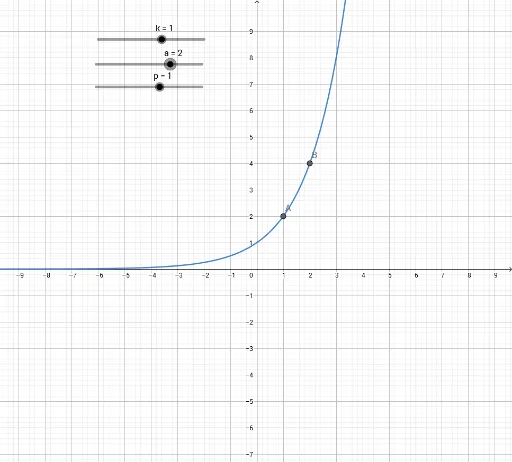
This GeoGebra example demonstrates the inverse relationship between exponential and logarithmic functions through dynamic geometric construction. It uses objects such as k, a, f, p, A, and B to build the functions, likely with a slider controlling the base 'a', and incorporates ellipses or linear regression to explore connections between algebraic functions and geometric shapes. Core concepts include exponential growth/decay, logarithms, inverse functions, symmetry about y=x, and conic sections. The construction highlights how changing parameters affects the graphs and how geometric tools can visualize algebraic properties. Suitable for high school or introductory college mathematics, especially for teaching function transformation, inverse relationships, and the interplay between algebra and geometry.
GeoGebra Commands & Parameters
Numeric k(1)Numeric a(2)f(x) = (k * a^(x))Numeric p(1)(p, f(p))(p + 1, f(p + 1))
AI Drawing Prompt Reference
Draw a coordinate plane with an exponential curve defined by a constant times a base raised to the x power, where the base is adjustable via a slider. Mark two points on the curve at x-values of a fixed number and that number plus one. Also plot the logarithmic function as its inverse, and include the line y=x to show symmetry. When the slider changes, the exponential and logarithmic curves should mirror each other across that line, illustrating their inverse relationship.
The prompt above was compiled from the original drawing commands and is for reference only.