
Exploring Volume
Loading the math board and drawing, please wait…
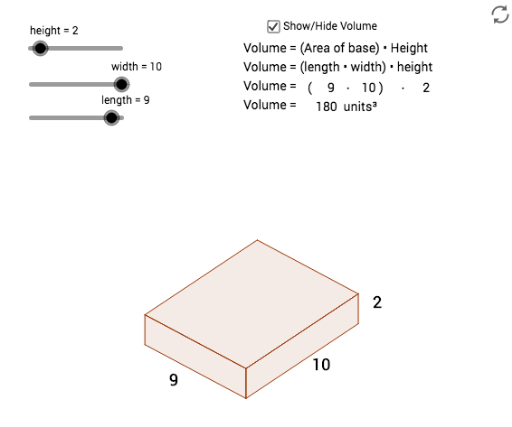
This example demonstrates the dynamic exploration of volume calculations for various geometric solids, such as pyramids, involving core mathematical concepts like volume formulas, exponentiation, step functions, logarithmic functions, polygons, and circumcircles. It utilizes GeoGebra commands like Vector, Line, Intersect, Segment, Polygon, and Midpoint for construction, making it suitable for high school students to intuitively understand and investigate volume computations and function applications.
GeoGebra Commands & Parameters
Vector(((0.75 * width), (0.5 * width))) → wVector((0, height)) → zVector(((-0.75 * length), (0.4 * length))) → uLine(C, z) → dLine(B, w) → eLine(B, u) → fLine(A, z) → gIntersect(f, g) → DIntersect(d, e) → ESegment(A, D) → hSegment(D, B) → iSegment(B, E) → jSegment(E, C) → kLine(D, j) → lLine(E, i) → mIntersect(l, m) → FSegment(D, F) → nSegment(F, E) → pPolygon(D, A, O, B) → poly1, d_1, a_1, o, b_1Polygon(D, F, E, B) → poly2, d_2, f_1, e_1, b_2Polygon(O, C, E, B) → poly3, o_1, c_1, e_2, b_3Midpoint(o_1) → GMidpoint(c_1) → HMidpoint(a_1) → I