
Exploring Translations by Mr. Watson (5)
Loading the math board and drawing, please wait…
In collections
Geometry Transformations
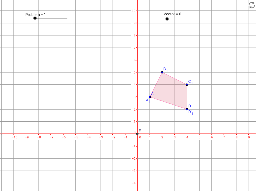
This example demonstrates the concept of translation. By observing the preimage point A and the corresponding image point A', you can understand the distance and direction of the movement. Commands used include Polygon, Vector, and Translate. Suitable for middle school and above students to learn geometric transformations.
GeoGebra Commands & Parameters
Polygon(A, B, C, D) → poly1, a, b, c, dVector(E, F) → uTranslate(A_1, u) → GTranslate(B_1, u) → HTranslate(C_1, u) → ITranslate(D_1, u) → JVector(E, K) → vTranslate(A_1, v) → LTranslate(B_1, v) → MTranslate(C_1, v) → NTranslate(D_1, v) → OVector(E, P) → wTranslate(A_1, w) → QTranslate(B_1, w) → RTranslate(C_1, w) → STranslate(D_1, w) → TTranslate(A, u) → A'_1Translate(B, u) → B'_1Translate(C, u) → C'_1Translate(D, u) → D'_1Polygon(A'_1, B'_1, C'_1, D'_1) → poly1', a', b', c', d'Translate(A_1, u) → UTranslate(B_1, u) → VTranslate(C_1, u) → WTranslate(D_1, u) → ZPolygon(U, V, W, Z) → poly2, u_1, v_1, w_1, zTranslate(A, v) → A'_2Translate(B, v) → B'_2Translate(C, v) → C'_2Translate(D, v) → D'_2Polygon(A'_2, B'_2, C'_2, D'_2) → poly1'_1, a'_1, b'_1, c'_1, d'_1Translate(A_1, v) → E_1Translate(B_1, v) → F_1Translate(C_1, v) → G_1Translate(D_1, v) → H_1Polygon(E_1, F_1, G_1, H_1) → poly3, e_1, f_1, g_1, h_1Translate(A, w) → A'_3Translate(B, w) → B'_3Translate(C, w) → C'_3Translate(D, w) → D'_3Polygon(A'_3, B'_3, C'_3, D'_3) → poly1'_2, a'_2, b'_2, c'_2, d'_2Translate(A_1, w) → I_1Translate(B_1, w) → J_1Translate(C_1, w) → K_1Translate(D_1, w) → L_1Polygon(I_1, J_1, K_1, L_1) → poly4, i_1, j_1, k_1, l_1Translate(A'_3, Vector[(0, 0)]) → A''Polygon(A_4, B_4, C_4, D_4) → poly1_2, a_2, b_2, c_2, d_2Polygon(A_3, B_3, C_3, D_3) → poly1_3, a_3, b_3, c_3, d_3Polygon(A_5, B_5, C_5, D_5) → poly1_4, a_4, b_4, c_4, d_4Polygon(A_6, B_6, C_6, D_6) → poly1_5, a_5, b_5, c_5, d_5