
Exploring Translation
Loading the math board and drawing, please wait…
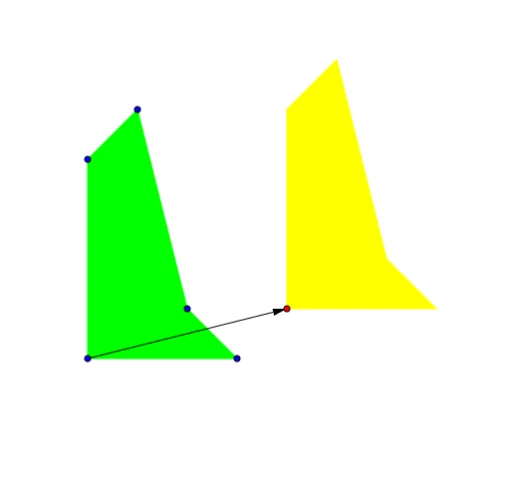
This example demonstrates the dynamic process of polygonal translation in two-dimensional space. Core math concepts include vectors, translation transformations, and polygon construction. GeoGebra commands like Polygon, Vector, and Translate are used in the construction. Suitable for high school coordinate geometry, vector, and transformation learning.
GeoGebra Commands & Parameters
Polygon(A, B, C, D, E) → poly1, a, b, c, d, eVector(B, F) → uTranslate(A, u) → A'Translate(B, u) → B'Translate(C, u) → C'Translate(D, u) → D'Translate(E, u) → E'Polygon(A', B', C', D', E') → poly1', a', b', c', d', e'
AI Drawing Prompt Reference
Draw a pentagon and create a vector from one vertex to another vertex of the same pentagon. Then translate all vertices of the pentagon by this vector to obtain a new set of vertices, and connect these new vertices to form a congruent pentagon. The two pentagons should have the same shape and size, with corresponding sides parallel, showing a clear translation transformation. The figure should include the original pentagon, the translated pentagon, and the vector indicating the direction of translation.
The prompt above was compiled from the original drawing commands and is for reference only.