
Exploring the Pelecoid: An Ancient Greek Surface
Loading the math board and drawing, please wait…
In collections
History of Maths
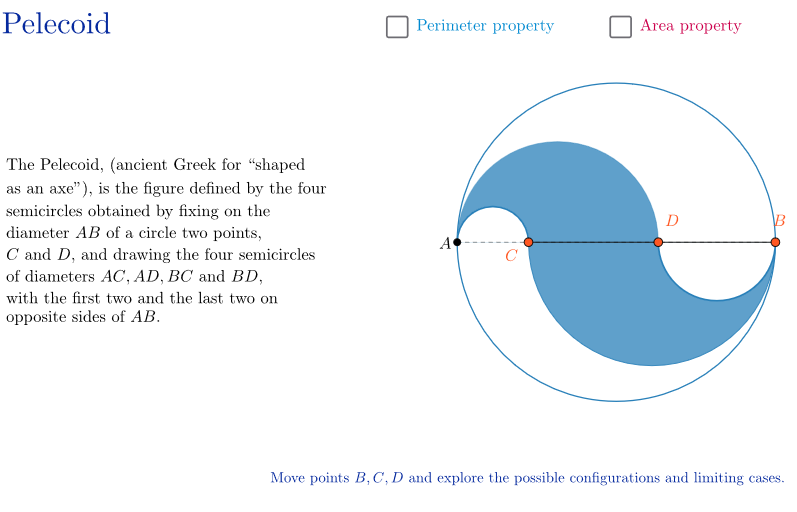
This example demonstrates the construction and area calculation of the Pelecoid, an ancient Greek geometric surface. It involves core mathematical concepts such as circle area, semicircle properties, coordinate geometry, and area calculation methods. The construction uses GeoGebra commands including Intersect, Point, Segment, Midpoint, Circle, and Semicircle to form the shape by combining these basic geometric elements. Suitable for high school or early college students studying geometry, it helps understand ancient Greek geometric ideas and area problems, and enhances geometric construction and analysis skills.
GeoGebra Commands & Parameters
Intersect(xAxis, yAxis) → APoint(xAxis) → BSegment(A, B) → iMidpoint(A, B) → KPoint(i) → CCircle(K, A) → cSegment(C, B) → fPoint(f) → DSemicircle(A, C) → dSemicircle(B, C) → eSemicircle(B, D) → gSemicircle(A, D) → hSemicircle(A, C) → kSemicircle(B, D) → p
AI Drawing Prompt Reference
Draw an ancient Greek geometric surface composed of multiple semicircles. Start by plotting the intersection of the coordinate axes and drawing a line segment connecting them. Find the midpoint of the segment and draw a circle centered at this point. Locate two points on the segment, then draw two semicircles with these points and the circle's center as centers. Finally, draw two more semicircles with these points as centers and combine all the semicircles to form the surface.
The prompt above was compiled from the original drawing commands and is for reference only.