
Exploring Spheres' Cross Sections
Loading the math board and drawing, please wait…
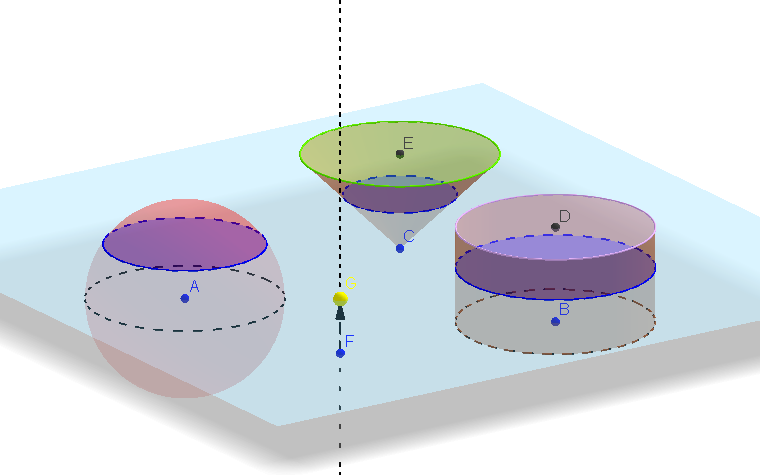
This GeoGebra example demonstrates the comparison of cross sections of spheres, cones, and cylinders. It involves the geometric properties of spheres, the shapes of cross sections, and the relationships between different geometric shapes. Using commands like OrthogonalLine, Circle, Vector, Translate, Sphere, and Cylinder, one can intuitively understand the characteristics of these geometric shapes. Suitable for middle school and above students or teachers.
GeoGebra Commands & Parameters
OrthogonalLine(A, xOyPlane) → aCircle(A, 2, a) → cVector(A, B) → uTranslate(c, u) → c'Sphere(A, 2) → bCylinder(B, D, 2) → d, e, f, gOrthogonalLine(F, xOyPlane) → jPoint(j) → GOrthogonalPlane(G, j) → lIntersectPath(l, b) → qIntersectPath(l, d) → rVector(A, E) → vTranslate(c, v) → c'_1Cone(E, C, 2) → h, k, iIntersectPath(l, h) → pCorner(p)Vector(F, G) → w
AI Drawing Prompt Reference
Draw a sphere with a radius of 2 and a circle that intersects the sphere's diameter perpendicularly. Then, draw a cone with a base radius of 2 and the apex coinciding with the sphere's center. Next, draw a cylinder with a base radius of 2 and a height equal to the cone's height. Finally, show the cross-sections of the sphere, cylinder, and cone and label the intersection points.
The prompt above was compiled from the original drawing commands and is for reference only.