
Exploring Special Parallelograms by Philip K
Loading the math board and drawing, please wait…
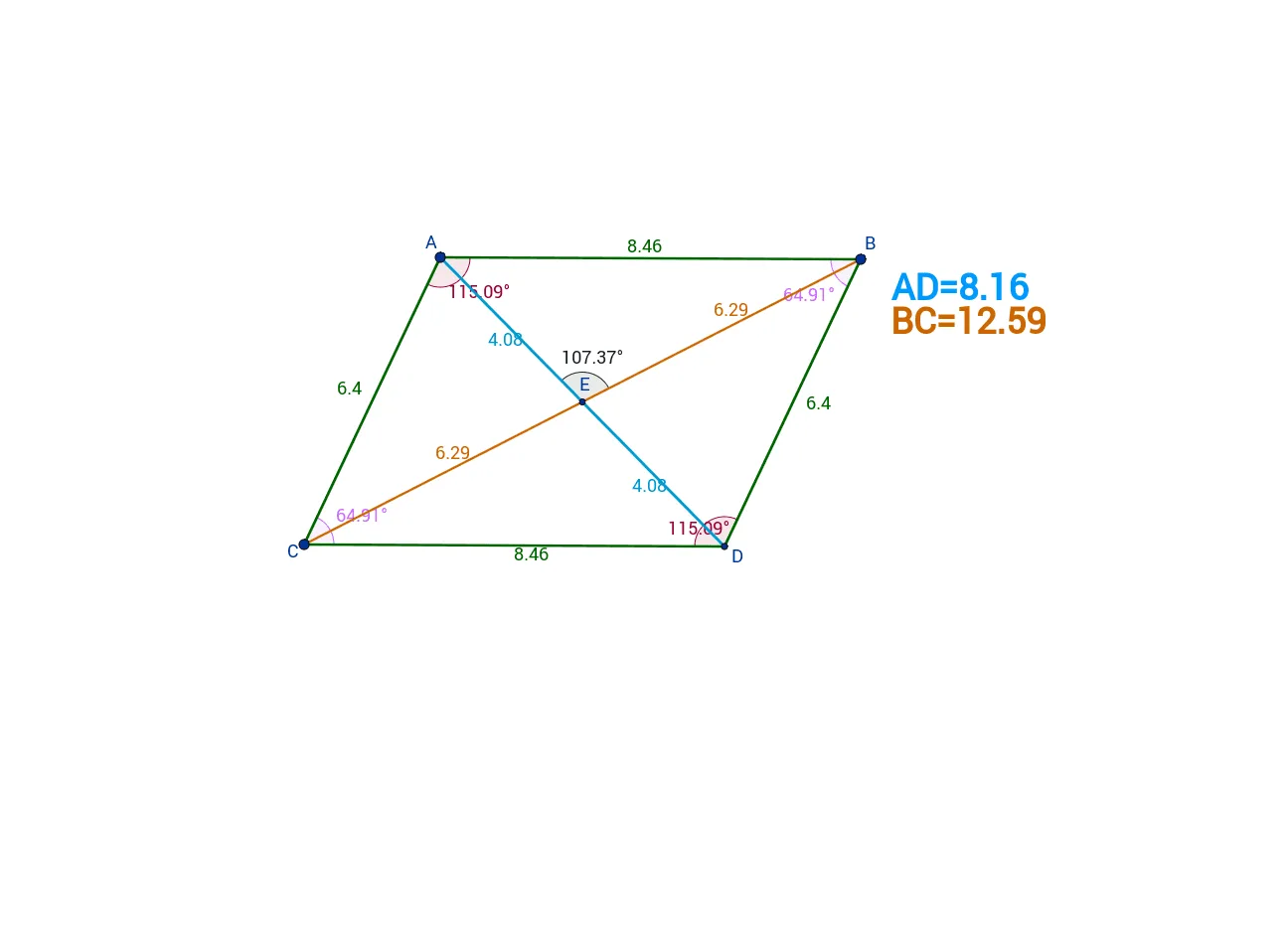
This example demonstrates the geometric properties of special parallelograms. Key mathematical concepts include the definition of a parallelogram, properties of diagonals, and area calculations. Construction involves GeoGebra commands such as Segment, Line, Intersect, and Angle. Suitable for middle or high school mathematics courses to understand geometric transformations and graph analysis.
GeoGebra Commands & Parameters
Segment(A, B) → aSegment(A, C) → bLine(B, b) → cLine(C, a) → dIntersect(c, d) → DSegment(C, D) → eSegment(D, B) → fSegment(A, D) → gSegment(B, C) → hIntersect(g, h) → ESegment(A, E) → iSegment(E, D) → jSegment(B, E) → kSegment(E, C) → lAngle(D, C, A) → αAngle(C, A, B) → βAngle(A, B, D) → γAngle(B, D, C) → δAngle(B, E, A) → ε
AI Drawing Prompt Reference
Draw a special parallelogram with points A, B, C, and D, and line segments a, b, c, d, e, f, g, h, i, j, k, and l. Start by drawing line segments AB and AC, then draw lines b and a from points B and C respectively, and find their intersection point D. Next, draw line segments CD, DB, AD, and BC, and find the intersection point E of AD and BC. Finally, draw line segments AE, ED, BE, and EC, and measure angles α, β, γ, δ, and ε.
The prompt above was compiled from the original drawing commands and is for reference only.