
Exploring Polygons and Angles
Loading the math board and drawing, please wait…
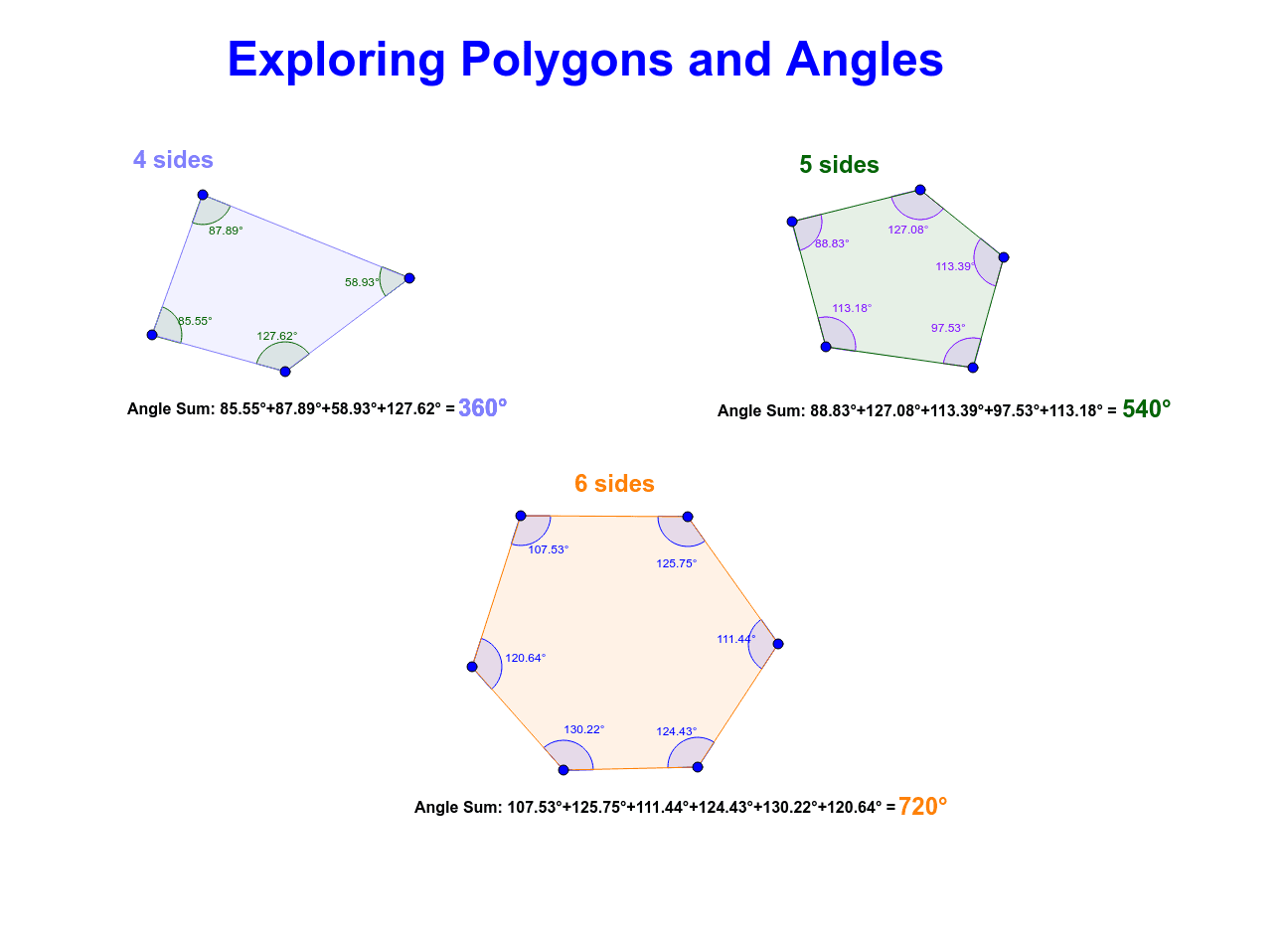
This example demonstrates how to explore the angle sums of quadrilaterals, pentagons, and hexagons using GeoGebra. It involves core math concepts like polygons, angle sums, and geometric construction. Key GeoGebra commands and objects used include Polygon and Angle. Suitable for middle school and above students to understand the patterns in polygon angle sums and develop geometric intuition and reasoning skills.
GeoGebra Commands & Parameters
Polygon(A, B, C, D) → poly1, a, b, c, dPolygon(E, F, G, H, I) → poly2, e, f, g, h, iPolygon(J, K, L, M, N, O) → poly3, j, k, l, m, n, oAngle(C, B, A) → αAngle(B, A, D) → βAngle(A, D, C) → γAngle(D, C, B) → δAngle(I, E, F) → εAngle(E, F, G) → ζAngle(F, G, H) → ηAngle(G, H, I) → θAngle(H, I, E) → ιAngle(O, J, K) → κAngle(J, K, L) → λAngle(K, L, M) → μAngle(L, M, N) → νAngle(M, N, O) → ξAngle(N, O, J) → οPolygon(A_1, B_1, C_1, D_1) → poly1_1, a_1, b_1, c_1, d_1Angle(C_1, B_1, A_1) → α_1Angle(B_1, A_1, D_1) → β_1Angle(A_1, D_1, C_1) → γ_1Angle(D_1, C_1, B_1) → δ_1Polygon(A_2, B_2, C_2, D_2) → poly1_2, a_2, b_2, c_2, d_2Angle(C_2, B_2, A_2) → α_2Angle(B_2, A_2, D_2) → β_2Angle(A_2, D_2, C_2) → γ_2Angle(D_2, C_2, B_2) → δ_2