
Exploring Quadrilateral Angle Sums
Loading the math board and drawing, please wait…
In collections
Interior and Exterior Angles of Polygons
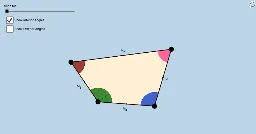
This example demonstrates how students can discover the sum of interior and exterior angles of a quadrilateral using transformations. Key math concepts include polygon angle sum theorems, geometric transformations. Constructed using GeoGebra commands like Ray, Point, Circle, Intersect, Segment, Angle, CircleSector, Vector, Translate, Dilate, If, Line, Polygon, Rotate, Mirror, Midpoint, CircleArc. Suitable for high school students learning about quadrilateral properties and transformation applications.
GeoGebra Commands & Parameters
Ray(P, A) → h_1Point(h_1) → RRay(A, R) → j_1Ray(A, B) → aCircle(A, 1.5) → gIntersect(g, j_1) → I_1,Intersect(g, a, 1) → HSegment(P, A) → l_1Intersect(g, l_1, 1) → H_1Segment(P, C) → k_1Circle(C, 1.5) → kIntersect(k, k_1) → Z,Ray(B, C) → bIntersect(k, b) → M, NPoint(a) → D_1Point(b) → E_1Ray(B, D_1) → eRay(C, E_1) → fPoint(e) → DPoint(f) → EAngle(A, C, B) → γAngle(D, B, C) → εAngle(E, C, A) → ζCircle(B, 1.5) → hIntersect(h, b, 1) → JIntersect(h, a, 1) → KIntersect(h, a, 2) → LCircleSector(B, J, K) → qCircleSector(B, L, J) → tVector(B, C) → uCircleSector(A, I_1, H) → c_1Vector(A, C) → vTranslate(q, u) → q'Segment(B, C) → lDilate(C, If[0 < j ≤ 1, j, 0], B) → C'Vector(B, C') → wTranslate(q, w) → q'_1Dilate(A, If[1 < j ≤ 2, 2 - j, 0], C) → C'_1Vector(A, C'_1) → mDilate(C, If[0 < n ≤ 1, n, 0], B) → C'_2Dilate(A, If[1 < n ≤ 2, 2 - n, 0], C) → A'Vector(B, C'_2) → u_1Vector(A, A') → v_1If(0 < n ≤ 1, Translate[t, u_1], Translate[t, u]) → e_1If(1 < n ≤ 2, Translate[c_1, v_1], Translate[c_1, v]) → f_1Ray(C, P) → g_1Point(g_1) → QRay(P, Q) → i_1Point(i_1) → SPoint(j_1) → TCircle(P, 1.5) → p_1Intersect(p_1, l_1) → U,Intersect(p_1, i_1) → V,Intersect(p_1, k_1) → W,CircleSector(P, U, W) → q_1Intersect(k, b, 2) → A_1Line(P, b) → b_1Intersect(p_1, b_1) → C_1, G_1Angle(B, A, P) → αVector(P, C) → iDilate(P, If[2 < j ≤ 3, 3 - j, 0], C) → P'Vector(P, P') → w_1Translate(q_1, w_1) → r_1CircleSector(C, N, Z) → sCircleSector(P, V, U) → t_1Dilate(P, If[2 < n ≤ 3, 3 - n, 0], C) → P'_1Vector(P, P'_1) → m_1If(2 < n ≤ 3, Translate[t_1, m_1], Translate[t_1, w_1]) → e_2Angle(H, A, I_1) → δAngle(V, P, U) → ηAngle(U, P, W) → θPolygon(A, B, C, P) → poly1, a_2, b_2, c_2, p_2Segment(A, C) → n_1Intersect(g, n_1) → F,Intersect(k, n_1) → G,Line(P, n_1) → cLine(B, n_1) → dCircleSector(C, Z, G) → d_1CircleSector(C, G, M) → s_1CircleSector(A, H, F) → d_2If(0 < j ≤ 1, Dilate[C, 1 - j, B]) → IIf(1 < j ≤ 2, Dilate[A, 2 - j, P]) → OIf(1 < j ≤ 2, Dilate[C, 2 - j, P]) → B_1Vector(C, I) → rVector(A, O) → u_2Translate(s_1, r) → h_2Rotate(d_2, 180°, A) → k_2Vector(A, B) → v_2Vector(C, B) → w_2Translate(s_1, w_2) → s_2Mirror(s_2, B) → t_2Vector(A, P) → i_2Vector(C, P) → j_2CircleSector(A, F, H_1) → f_2Translate(f_2, i_2) → d_3Vector(C, B_1) → l_2Translate(d_1, j_2) → f_3Mirror(f_3, P) → g_3Translate(f_2, u_2) → h_3Translate(d_1, l_2) → k_3Segment(A, B) → m_2Polygon(A, B, C) → poly2, c_4, a_3, b_3Polygon(A, C, P) → poly3, p_4, a_4, c_5Midpoint(m_2) → M_4Midpoint(l) → J_1Midpoint(k_1) → M_2Midpoint(l_1) → M_3Segment(J, C) → n_2Segment(J_1, C) → i_3Rotate(J_1, If[0 < j ≤ 1, (((-j) * 180))°, -180°], J_1) → M_1Rotate(C, If[0 < j ≤ 1, (((-j) * 180))°, -180°], J_1) → C'_3Segment(M_1, C'_3) → j_3Rotate(s_1, If[0 < j ≤ 1, (((-j) * 180))°, -180°], J_1) → r_3Segment(J_1, B) → r_2Rotate(d_2, If[0 < j ≤ 1, ((j * 180))°, 180°], M_4) → pRotate(A, If[0 < j ≤ 1, ((j * 180))°, 180°], M_4) → A'_1Segment(M_4, A'_1) → g_2Rotate(C, If[1 < j ≤ 2, (((j - 1) * 180))°, 180°], M_2) → C'_4Segment(M_2, C'_4) → q_2Rotate(d_1, If[1 < j ≤ 2, (((j - 1) * 180))°, 180°], M_2) → c_3Rotate(A, If[1 < j ≤ 2, (((-(j - 1)) * 180))°, 180°], M_3) → A'_2Segment(M_3, A'_2) → e_3Rotate(f_2, If[1 < j ≤ 2, (((-(j - 1)) * 180))°, 180°], M_3) → p_3CircleArc(C, G, M) → q_3CircleArc(A, H, F) → s_3CircleArc(C, Z, G) → t_3CircleArc(A, F, H_1) → d_4Segment(M_2, C) → l_3Segment(M_2, P) → m_3Segment(P, M_3) → n_3Segment(M_3, A) → b_4Segment(A, M_4) → e_4Segment(M_4, B) → f_4
AI Drawing Prompt Reference
Draw a quadrilateral and demonstrate the sum of its interior and exterior angles. Start by constructing the four sides of the quadrilateral, then draw the interior and exterior angles at each vertex, using different colors. Next, use geometric transformations like rotation and reflection to show how parts of the quadrilateral can be moved to verify the sum of interior and exterior angles. Finally, represent the angles as sectors and label their measures.
The prompt above was compiled from the original drawing commands and is for reference only.