
Exploring Parallelograms
Loading the math board and drawing, please wait…
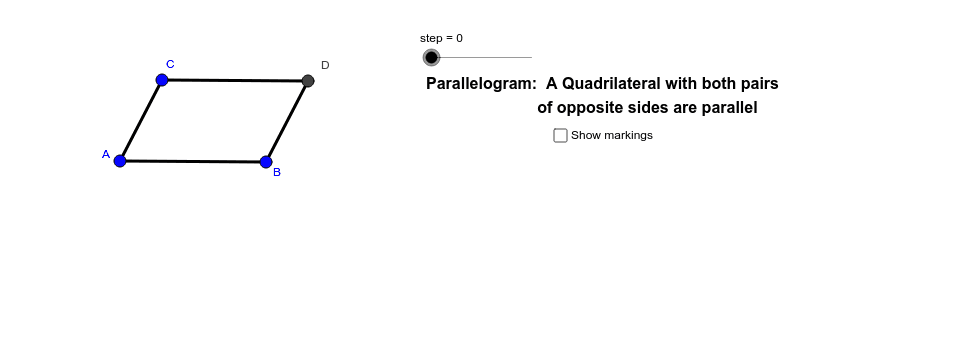
This example demonstrates the geometric properties and construction methods of parallelograms. It involves core concepts like parallel lines, diagonals, vectors, angles, and midpoints. The construction uses GeoGebra commands such as Segment, Line, Intersect, Distance, Midpoint, and Angle. Suitable for high school mathematics education to understand symmetry and calculations in parallelograms.
GeoGebra Commands & Parameters
Segment(A, B) → aLine(C, a) → bSegment(C, A) → cLine(B, c) → dIntersect(b, d) → DSegment(C, D) → eSegment(B, D) → fDistance(c, e) → gDistance(f, a) → hMidpoint(c) → EMidpoint(e) → FMidpoint(f) → GMidpoint(a) → HSegment(A, B) → iSegment(C, D) → jSegment(A, C) → kSegment(B, D) → lAngle(C, D, B) → αAngle(A, C, D) → βAngle(B, A, C) → γAngle(D, B, A) → δSegment(C, B) → pSegment(D, A) → qIntersect(p, q) → ISegment(C, I) → rSegment(I, B) → sSegment(D, I) → tSegment(I, A) → a_1Distance(a_1, t) → uDistance(s, r) → vMidpoint(r) → JMidpoint(s) → KMidpoint(t) → LMidpoint(a_1) → MSegment(A, I) → b_1Segment(I, D) → c_1Segment(C, I) → d_1Segment(I, B) → e_1Segment(A, C) → f_1Segment(B, D) → g_1Segment(A, B) → h_1Segment(C, D) → i_1
AI Drawing Prompt Reference
Draw a parallelogram, highlighting its properties: opposite sides are parallel and equal in length, and diagonals bisect each other. Label the vertices, opposite sides, diagonals, the intersection point of the diagonals, and the midpoints of each side. Measure and display the lengths of the diagonals and the measures of the interior angles. Then, connect the intersection point of the diagonals to each vertex, forming four congruent triangles, and label the midpoints of these triangles.
The prompt above was compiled from the original drawing commands and is for reference only.