
Exploring Integers on a Vertical Number Line
Loading the math board and drawing, please wait…
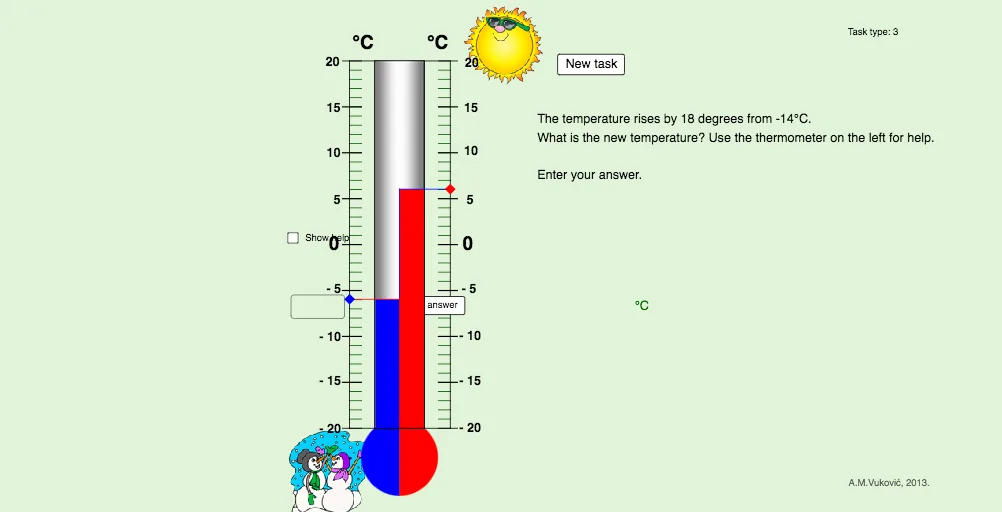
This GeoGebra example demonstrates integers on a vertical number line, allowing students to visualize positive and negative numbers, their order, and sequences. Core mathematical concepts include integers, number lines, sequences, and series. The construction uses commands such as Line, Point, Segment, Sequence, Dilate, Mirror, Rotate, and Textfield to build the number line, generate integer points, and enable interactive input. Random and Shuffle commands add variability, while PolyLine and Text label the values. Suitable for upper elementary and middle school students learning integer concepts, number line usage, and pattern recognition in an interactive environment.
GeoGebra Commands & Parameters
Line(A_2, A_1) → cPoint(c) → P_0Dilate(B_1, 1 / brPodjela, A_1) → B_pPoint(Circle[A, a]) → BSegment(A, B) → bSequence(Segment[Translate[A_2, Vector[(i * Vector[A_1, B_p])]], Translate[A_1, Vector[(i * Vector[A_1, B_p])]]], i, 1, brPodjela - 1) → lista1Line(B_2, B_1) → dPoint(c) → C_1Point(c) → C_2Point(d) → D_1Point(d) → D_2Dilate(D_1, 1 / brPodjela, C_1) → D_pSequence(Segment[Translate[C_2, Vector[(i * Vector[C_1, D_p])]], Translate[C_1, Vector[(i * Vector[C_1, D_p])]]], i, 1, brPodjela - 1) → lista2Line(B_p, D_p) → ePoint(e) → CLine(C, yAxis) → fPoint(f) → DCircle(D, C) → gMirror(C, D) → C'CircleSector(D, C, C') → hCircleSector(D, C', C) → kSegment(A_1, B_1) → iPoint(i) → ELine(E, xAxis) → jIntersect(f, c) → FIntersect(f, j) → GLine(H, yAxis) → lIntersect(l, c) → IIntersect(l, j) → JPolygon(F, I, J, G) → mnogokut1, f_1, i_1, j_1, g_1Line(K, yAxis) → mSegment(C_2, D_2) → nPoint(n) → LLine(L, xAxis) → pIntersect(p, f) → MIntersect(m, p) → NIntersect(m, c) → OPolygon(O, F, M, N) → mnogokut2, o, f_2, m_1, n_1Segment(A_1, C_2) → qSegment(B_1, D_2) → rSegment(E, G) → sSegment(L, M) → tSegment(A_2, P_0) → a_1Segment(R_1, P_1) → b_1Segment(R_2, P_2) → c_1Segment(R_3, P_3) → d_1Segment(R_4, P_4) → e_1Segment(R_5, P_5) → h_1Segment(R_6, P_6) → k_1Segment(R_7, P_7) → l_1Segment(B_2, P_8) → p_1Point(c) → Q_0Segment(Q_8, D_1) → q_1Segment(Q_7, T_7) → r_1Segment(Q_6, T_6) → s_1Segment(Q_5, T_5) → t_1Segment(Q_4, T_4) → a_2Segment(Q_3, T_3) → b_2Segment(Q_2, T_2) → c_2Segment(Q_1, T_1) → d_2Segment(Q_0, C_1) → e_2Segment(F, C') → g_2Point(i) → PPoint(i) → QPoint(n) → RPoint(n) → SIntersect(c, l) → TIntersect(c, m) → USegment(U, T) → h_2Midpoint(h_2) → VSegment(V, T) → i_2Midpoint(i_2) → WSegment(V, U) → j_2Midpoint(j_2) → ZLine(R, xAxis) → k_2Line(Z, yAxis) → l_2Intersect(m, k_2) → E_1Intersect(l_2, k_2) → F_1Polygon(U, Z, F_1, E_1) → mnogokut3, u_1, z, f_3, e_3Segment(R, F_1) → m_2Line(Q, xAxis) → n_2Line(V, yAxis) → p_2Intersect(n_2, p_2) → G_1Intersect(n_2, l_2) → H_1Polygon(V, G_1, H_1, Z) → mnogokut4, v, g_3, h_3, z_1Segment(Q, H_1) → q_2Line(S, xAxis) → r_2Line(W, yAxis) → s_2Intersect(r_2, s_2) → I_1Intersect(r_2, p_2) → J_1Polygon(V, W, I_1, J_1) → mnogokut5, v_1, w, i_3, j_3Segment(S, I_1) → t_2Line(P, xAxis) → a_3Intersect(s_2, a_3) → K_1Intersect(a_3, l) → L_1Polygon(W, T, L_1, K_1) → mnogokut6, w_1, t_3, l_3, k_3Segment(P, K_1) → b_3Sequence(Random[-20, 20] + (0 * u), i, 1, 10) → Zad1SviBrojeviUnique(Zad1SviBrojevi) → Zad1UniqueShuffle(Zad1Unique) → Zad1Rnd, {-20, -9, 19, -8, 9, 18, 20, -1, 14}Sequence(Element[Zad1Rnd, i], i, 1, 4) → Zad1OdabraniPoint(xAxis) → M_1Point(xAxis) → N_1Point(xAxis) → O_1Point(xAxis) → S_1Line(M_1, yAxis) → c_3Line(N_1, yAxis) → d_3Line(O_1, yAxis) → m_3Line(S_1, yAxis) → n_3Point(yAxis) → U_1Line(U_1, xAxis) → p_3Intersect(p_3, c_3) → V_1Intersect(p_3, d_3) → W_1Intersect(p_3, m_3) → Z_1Intersect(p_3, n_3) → E_2Circle(V_1, 1) → q_3Circle(W_1, 1) → r_3Circle(Z_1, 1) → s_3Circle(E_2, 1) → c_4OrthogonalLine(V_1, p_3) → a_4Intersect(q_3, a_4) → F_2, G_2Intersect(q_3, p_3) → H_2, I_2Polygon(F_2, I_2, 4) → mnogokut7, b_4, d_4, e_4, f_4, J_2, K_2Point(r_3) → L_2Rotate(L_2, 60°, W_1) → M_2Angle(L_2, W_1, M_2) → αRotate(L_2, 300°, W_1) → N_2Angle(N_2, W_1, L_2) → βPolygon(N_2, M_2, 3) → mnogokut8, g_4, h_4, i_4, O_2Point(s_3) → S_2Rotate(S_2, 30°, Z_1) → U_2Angle(S_2, Z_1, U_2) → γRotate(S_2, 330°, Z_1) → V_2Angle(V_2, Z_1, S_2) → δPolygon(V_2, U_2, 6) → mnogokut9, j_4, B_3, k_4, l_4, m_4, n_4, p_4, W_2, Z_2, A_3Point(c_4) → C_3Rotate(C_3, 60°, E_2) → D_3Rotate(C_3, 300°, E_2) → E_3Angle(E_3, E_2, C_3) → εPolygon(E_3, D_3, 3) → mnogokut10, q_4, r_4, s_4, F_3Element(Zad1Odabrani, 1) → Zad1br1Element(Zad1Odabrani, 2) → Zad1br2Element(Zad1Odabrani, 3) → Zad1br3Element(Zad1Odabrani, 4) → Zad1br4If(Zad1br1 > Zad1br2, 1, 0) → Gscore_1If(Zad1br1 > Zad1br4, 1, 0) → Gscore_3If(Zad1br1 > Zad1br3, 1, 0) → Gscore_2If(Zad1br2 > Zad1br1, 1, 0) → Hscore_1If(Zad1br2 > Zad1br3, 1, 0) → Hscore_2If(Zad1br2 > Zad1br4, 1, 0) → Hscore_3If(Zad1br3 > Zad1br1, 1, 0) → Iscore_1If(Zad1br3 > Zad1br2, 1, 0) → Iscore_2If(Zad1br3 > Zad1br4, 1, 0) → Iscore_3If(Zad1br4 > Zad1br1, 1, 0) → Jscore_1If(Zad1br4 > Zad1br2, 1, 0) → Jscore_2If(Zad1br4 > Zad1br3, 1, 0) → Jscore_3If((abs(x(G_3) - x(V_1)) ≤ 0.1 ∨ abs(x(G_3) - x(W_1)) ≤ 0.1 ∨ abs(x(G_3) - x(Z_1)) ≤ 0.1 ∨ abs(x(G_3) - x(E_2)) ≤ 0.1) ∧ abs(y(G_3) - y(U_1)) ≤ 0.1, 1, 0) → GMovedIf((abs(x(H_3) - x(V_1)) ≤ 0.1 ∨ abs(x(H_3) - x(W_1)) ≤ 0.1 ∨ abs(x(H_3) - x(Z_1)) ≤ 0.1 ∨ abs(x(H_3) - x(E_2)) ≤ 0.1) ∧ abs(y(H_3) - y(U_1)) ≤ 0.1, 1, 0) → HMovedIf((abs(x(I_3) - x(V_1)) ≤ 0.1 ∨ abs(x(I_3) - x(W_1)) ≤ 0.1 ∨ abs(x(I_3) - x(Z_1)) ≤ 0.1 ∨ abs(x(I_3) - x(E_2)) ≤ 0.1) ∧ abs(y(I_3) - y(U_1)) ≤ 0.1, 1, 0) → IMovedIf((abs(x(J_3) - x(V_1)) ≤ 0.1 ∨ abs(x(J_3) - x(W_1)) ≤ 0.1 ∨ abs(x(J_3) - x(Z_1)) ≤ 0.1 ∨ abs(x(J_3) - x(E_2)) ≤ 0.1) ∧ abs(y(J_3) - y(U_1)) ≤ 0.1, 1, 0) → JMovedIf(abs(x(G_3) - GscoreTOT) ≤ 0.1 ∧ abs(y(G_3) - y(U_1)) ≤ 0.1, 1, 0) → GTrueIf(abs(x(H_3) - HscoreTOT) ≤ 0.1 ∧ abs(y(H_3) - y(U_1)) ≤ 0.1, 1, 0) → HTrueIf(abs(x(I_3) - IscoreTOT) ≤ 0.1 ∧ abs(y(I_3) - y(U_1)) ≤ 0.1, 1, 0) → ITrueIf(abs(x(J_3) - JscoreTOT) ≤ 0.1 ∧ abs(y(J_3) - y(U_1)) ≤ 0.1, 1, 0) → JTrueIf(GTrue ≟ 1 ∧ HTrue ≟ 1 ∧ ITrue ≟ 1 ∧ JTrue ≟ 1, "Excellent! The correct order!", "This is not the correct solution. Use the thermometer on the left for help.") → Zad1ProvjeraElement(Zad1Odabrani, 1) → Zad2br1Element(Zad1Odabrani, 2) → Zad2br2If(Zad2br1 > Zad2br2, 1, 0) → GreaterTrueIf(Zad2br1 < Zad2br2, 1, 0) → LessTrueIf(GreaterTrue ≟ 1 ∧ ClickedGreater ≟ 1 ∨ LessTrue ≟ 1 ∧ ClickedLess ≟ 1, "Excellent! You have compared numbers correctly.", "You didn't compare numbers correctly. Next time use the thermometer on the left for help.") → Zad2ProvjeraTextfield(Zad3Upisano) → txtPolje1Textfield(Zad4Upisano) → txtPolje2Textfield(Zad5Upisano) → txtPolje3Textfield(Zad6Upisano) → txtPolje4Random(0, 40) → promjKoordKLine(K_3, xAxis) → t_4Intersect(t_4, l) → L_3Intersect(t_4, m) → M_3Polygon(O, I, L_3, M_3) → mnogokut11, o_3, i_5, l_5, m_5Segment(L_3, K_3) → a_5Circle(D, C) → c_5Textfield(Zad7Upisano) → txtPolje5Dilate(O_3, 1 / brPodjela, N_3) → S_3Sequence(Segment[Translate[U_3, Vector[(i * Vector[N_3, S_3])]], Translate[N_3, Vector[(i * Vector[N_3, S_3])]]], i, 0, brPodjela) → lista3Sequence(Random[-20, 20] + (0 * u), i, 1, 8) → Zad8BrojeviElement(Zad8Brojevi, 1) → C1Element(Zad8Brojevi, 2) → C2Element(Zad8Brojevi, 3) → C3Element(Zad8Brojevi, 4) → C4Element(Zad8Brojevi, 5) → C5Element(Zad8Brojevi, 6) → C6Element(Zad8Brojevi, 7) → C7Element(Zad8Brojevi, 8) → C8PolyLine({V_3, W_3, Z_3, A_4, B_4, C_4, D_4, E_4}) → b_5Line(O_3, xAxis) → d_5Line(N_3, xAxis) → e_5Point(xAxis) → F_4Line(F_4, yAxis) → f_5Intersect(f_5, d_5) → G_4Intersect(f_5, e_5) → H_4Polygon(N_3, H_4, G_4, O_3) → mnogokut12, n_5, h_5, g_5, o_4Line(L_4, xAxis) → q_5Intersect(q_5, h_5) → Z_4Segment(L_4, Z_4) → j_5Point(h_5) → U_4Line(U_4, xAxis) → k_5Intersect(k_5, o_4) → V_4Segment(V_4, U_4) → p_5Line(I_4, xAxis) → r_5Line(J_4, xAxis) → s_5Line(K_4, xAxis) → t_5Line(M_4, xAxis) → a_6Line(N_4, xAxis) → b_6Line(O_4, xAxis) → c_6Intersect(r_5, h_5) → W_4Intersect(s_5, h_5) → A_5Intersect(t_5, h_5) → B_5Intersect(a_6, h_5) → C_5Intersect(b_6, h_5) → D_5Intersect(c_6, h_5) → E_5Segment(I_4, W_4) → d_6Segment(J_4, A_5) → e_6Segment(K_4, B_5) → f_6Segment(M_4, C_5) → g_6Segment(N_4, D_5) → h_6Segment(O_4, E_5) → i_6Random(1, 5) → Zad8RndNumElement(Zad8Odgovori, Zad8RndNum) → Zad8AnswerText(Element[Zad8Pitanja, Zad8RndNum]) → Zad8QuestionTextfield(Zad8Upisano) → txtPolje6
AI Drawing Prompt Reference
Draw a vertical number line from -10 to 10 with integer points. Start by drawing a vertical line as the number line and marking the origin point. Then, generate integer points equally spaced above and below the origin. Connect adjacent integer points with line segments to form the integer sequence on the number line. Finally, add some auxiliary lines and labels, such as vertical and horizontal lines, circles, and arcs, to enhance the readability and interactivity of the number line.
The prompt above was compiled from the original drawing commands and is for reference only.