
Exploring Exterior Angle Relationships of Polygons
Loading the math board and drawing, please wait…
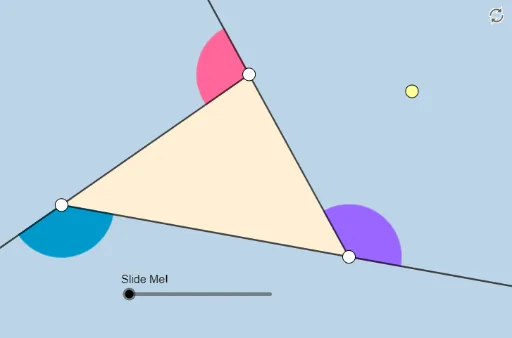
This interactive GeoGebra example dynamically illustrates the relationships among exterior angles of polygons, demonstrating that the sum of exterior angles of any convex polygon is always 360°. Core mathematical concepts include the definition of exterior angles, the exterior angle sum theorem, the supplementary relationship between interior and exterior angles, and the intuitive accumulation of rotated vectors. Construction highlights: using Ray and Polygon commands to build the polygon, Circle and Intersect to locate auxiliary points, Angle tool to mark exterior angles, and transformation commands such as Dilate, Vector, and Translate to adjust the figure dynamically. CircleSector and Min enhance the visual representation. This resource is suitable for middle and high school students learning polygon properties, and serves as a hands-on tool for teachers to guide students in verifying the exterior angle sum theorem through observation and manipulation, fostering spatial reasoning and deductive thinking.
GeoGebra Commands & Parameters
Ray(A, B) → fRay(B, C) → gRay(C, A) → hPolygon(A, B, C) → t1, c, a, bMin({a, b, c}) → dCircle(C, (0.25 * d)) → eCircle(A, (0.25 * d)) → kCircle(B, (0.25 * d)) → pIntersect(e, g, 2) → EIntersect(e, h, 1) → FIntersect(k, h, 2) → GIntersect(k, f, 1) → HIntersect(p, f, 2) → IIntersect(p, g, 1) → JCircleSector(C, E, F) → qCircleSector(A, G, H) → rCircleSector(B, I, J) → sDilate(A, If[0 < u ≤ 1, 1 - u, 0], D) → A'Dilate(B, If[0 < u ≤ 1, 1 - u, 0], D) → B'Dilate(C, If[0 < u ≤ 1, 1 - u, 0], D) → C'Vector(C, C') → vVector(A, A') → wVector(B, B') → iTranslate(q, v) → q'Translate(r, w) → r'Translate(s, i) → s'CircleSector(C, F, E) → tCircleSector(A, H, G) → c_1CircleSector(B, J, I) → d_1Angle(A, C, B) → αTranslate(c_1, w) → e_1Translate(t, v) → t'Translate(d_1, i) → f_1