
Exploring Dilations under Dynamic Scale Factors
Loading the math board and drawing, please wait…
In collections
Dilations
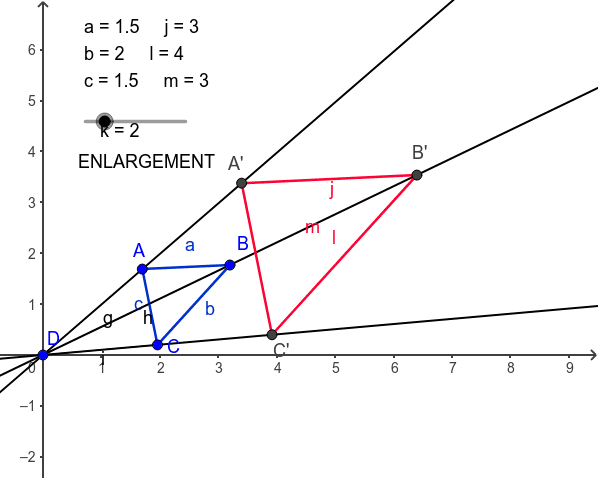
This GeoGebra example dynamically demonstrates the geometric transformation of dilation, showing how a dynamic scale factor affects the lengths of the pre-image and the image. The core mathematical concepts include geometric similarity, scale factors, center of dilation, and the proportional relationship between corresponding side lengths. To construct this, the user utilizes key GeoGebra commands such as Segment, Line, Circle, and Intersect to define points A, B, C, D, and their transformed images A', B', C'. The dynamic sliders and intersection tools allow for real-time visualization of how coordinates scale. This resource is ideal for middle school and high school students studying geometry, similarity, and coordinate transformations, providing an interactive bridge between algebraic scale factors and visual geometric resizing.
GeoGebra Commands & Parameters
Segment(B, A) → aSegment(A, C) → cSegment(C, B) → bLine(D, A) → dLine(D, B) → eLine(D, C) → fSegment(D, A) → gSegment(D, B) → hSegment(D, C) → iCircle(D, p) → sIntersect(s, d) → E, A'Circle(D, q) → tIntersect(t, e) → G, B'Circle(D, r) → c1Intersect(c1, f) → I, C'Segment(A', B') → jSegment(B', C') → lSegment(C', A') → m
AI Drawing Prompt Reference
Draw a dilation transformation diagram centered at point D. Construct triangle ABC with its three sides. Draw rays from D through A, B, and C respectively. Use three circles centered at D with varying radii to intersect these rays, obtaining dilated points A', B', and C' on the corresponding rays. Connect A', B', and C' to form the dilated triangle A'B'C', illustrating the similarity relationship between the original triangle and its transformed image.
The prompt above was compiled from the original drawing commands and is for reference only.