
Exploring Diagonals of an Isosceles Trapezoid
Loading the math board and drawing, please wait…
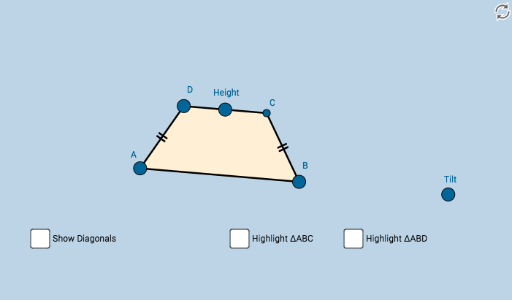
This applet demonstrates the properties of diagonals in an isosceles trapezoid. Key mathematical concepts include the definition and properties of an isosceles trapezoid. Using GeoGebra commands such as Line, Ray, Point, Midpoint, etc., dynamic exploration of the length and position of the diagonals in an isosceles trapezoid is possible. Suitable for middle school and above students or teachers for teaching purposes.
GeoGebra Commands & Parameters
Line(A, B_1) → aRay(A, B_1) → bPoint(b) → BMidpoint(A, B) → D_1Line(A, B) → cSlope(c) → dOrthogonalLine(D_1, c) → gPoint(g) → E_1Ray(D_1, E_1) → hPoint(h) → FSlope(h) → iLine(F, c) → lPoint(l) → GPoint(l) → HRay(F, G) → mRay(F, H) → nPoint(m) → DMirror(D, h) → I'Dilate(A, If[0 < o ≤ 1, 1 - o, 0], B) → A'Segment(A, A') → pDilate(A, If[1 < o ≤ 2, 2 - o, 0], D) → A'_1Segment(A, A'_1) → qSegment(A, B) → rSegment(B, I') → sSegment(I', D) → tSegment(D, A) → a_1Circle(A, (0.2 * Min[a_1, r])) → c_1Circle(D, (0.2 * Min[a_1, r])) → d_1Intersect(d_1, a_1, 1) → JIntersect(d_1, t, 1) → KIntersect(c_1, r, 1) → LIntersect(c_1, a_1, 1) → MDilate(D, If[2 < o ≤ 3, 3 - o, 0], I') → I'_1Segment(D, I'_1) → b_1Dilate(A, If[3 < o ≤ 4, 4 - o, 0], B) → A'_2Vector(A, A'_2) → uTranslate(A, u) → A'_3Translate(A'_1, u) → NSegment(A'_3, N) → q'OrthogonalLine(A, r) → g_1Point(g_1) → OAngle(D, A, O) → αAngle(I', B, A) → βRotate(A'_3, If[4 < o ≤ 5, (((o - 4) * 2) * α), (2 * α)], B) → PRotate(N, If[4 < o ≤ 5, (((o - 4) * 2) * α), (2 * α)], B) → CSegment(P, C) → q''Dilate(A, If[5 < o ≤ 6, 6 - o, 0], B) → A'_4Vector(A, A'_4) → vDilate(D, If[7 < o ≤ 8, 8 - o, 0], I') → I'_2Vector(D, I'_2) → wDilate(A, If[9 < o ≤ 10, 10 - o, 0], I') → A'_5Segment(A, A'_5) → i_1Dilate(A, If[10 < o ≤ 11, 11 - o, 0], D) → A'_6Vector(A, A'_6) → u_1Translate(A, u_1) → A'_7Translate(A'_5, u_1) → QSegment(A'_7, Q) → j_1Segment(D, B) → l_1Angle(L, A, I') → γRotate(A'_7, If[11 < o ≤ 12, ((-(o - 11)) * (2 * γ)), (-2 * γ)], D) → RRotate(Q, If[11 < o ≤ 12, ((-(o - 11)) * (2 * γ)), (-2 * γ)], D) → Q'Segment(R, Q') → m_1Polygon(A, B, I', D) → poly1, a_2, c_2, i', i_2Intersect(i_1, m_1) → EDistance(A, E) → distanceASDistance(E, C) → distanceSN'Distance(E, B) → distanceSCDistance(E, D) → distanceSIAngle(B, A, E) → δAngle(E, B, A) → εAngle(C, B, E) → ζAngle(E, A, D) → ηAngle(A, D, E) → θAngle(E, D, C) → ιAngle(D, C, E) → κAngle(B, E, C) → λAngle(E, C, B) → μAngle(A, E, B) → νPolygon(A, B, C) → poly2, c_3, a_3, b_2Segment(A, C) → h_1Mirror(A, h_1) → A'_8Mirror(B, h_1) → B'Mirror(C, h_1) → C'Polygon(A'_8, B', C') → poly2', c', a'_8, b'Polygon(D, A, B) → poly3, b_3, d_2, a_4Segment(D, B) → p_1Mirror(D, p_1) → D'Mirror(A, p_1) → A'_9Mirror(B, p_1) → B'_1Polygon(D', A'_9, B'_1) → poly3', b'_1, d', a'_9
AI Drawing Prompt Reference
Draw an isosceles trapezoid and explore the properties of its diagonals. Start by creating two parallel line segments AB and CD, with AB being longer. Then, take points A and B on AB, and points C and D on CD. Connect AD and BC to form the isosceles trapezoid. By constructing midpoints D1 and E1, observe the relationship between the lengths of diagonals AD and BC. Finally, use mirroring and translation to demonstrate the rotation and symmetry of the diagonals.
The prompt above was compiled from the original drawing commands and is for reference only.