
Exploring Areas of Squares and Right Triangles
Loading the math board and drawing, please wait…
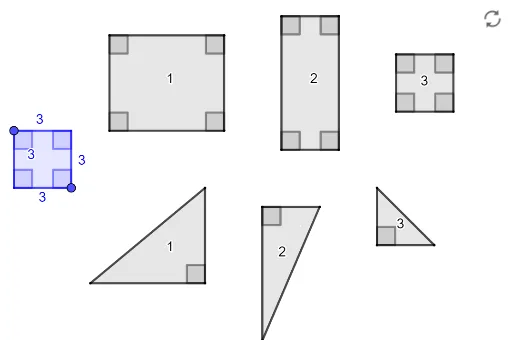
① This GeoGebra example dynamically demonstrates the relationships between the areas of squares and the side lengths of right triangles, extending to rectangles, composite shapes, and even cylinder volumes. ② Core mathematical concepts include area formulas, the Pythagorean theorem, properties of right triangles, polygon area calculations, and an introduction to volume of solids. ③ Construction highlights: using GeoGebra commands such as Polygon, Line, Angle, OrthogonalLine, and Intersect, the applet builds multiple squares (e.g., q2, q3, q4) and right triangles (e.g., t2, t3), with points (A_1, B_1, H, I, J, etc.) and segments (h_1, i, j, k, etc.) precisely controlling positions and sizes, allowing dynamic adjustments to observe area changes. ④ Suitable for Grade 8 mathematics students, this resource supports inquiry-based learning about area-side relationships, verifying the Pythagorean theorem, and serves as a teaching aid to bridge planar and spatial reasoning.
GeoGebra Commands & Parameters
Polygon(H, I, J, K) → q2, h_1, i, j, kPolygon(L, M, N, O) → q3, l_1, m_1, n_1, oPolygon(P, S, Q, R) → q4, p_1, s, q_1, rPolygon(T, U, V) → t2, v, t, uPolygon(W, Z, C_1) → t3, c_1, w, z_1Polygon(D_1, E_1, F_1) → t4, i_1, d_1, e_1Line(A_1, B_1) → fAngle(H, I, J) → εAngle(I, J, K) → ζAngle(J, K, H) → ηAngle(K, H, I) → θAngle(M, N, O) → ιAngle(N, O, L) → κAngle(O, L, M) → λAngle(L, M, N) → μAngle(R, Q, S) → νAngle(Q, S, P) → ξAngle(S, P, R) → οAngle(P, R, Q) → ρAngle(C_1, Z, W) → σAngle(V, T, U) → τAngle(E_1, D_1, F_1) → υOrthogonalLine(A, f) → gOrthogonalLine(B, f) → hLine(A, f) → lLine(B, f) → mIntersect(g, m) → CIntersect(h, l) → DAngle(A, C, B) → αAngle(C, B, D) → βAngle(B, D, A) → γAngle(D, A, C) → δPolygon(C, B, D, A) → q1, c, b, d, a