
Explore Sine and Cosine Ratios on the Unit Circle
Loading the math board and drawing, please wait…
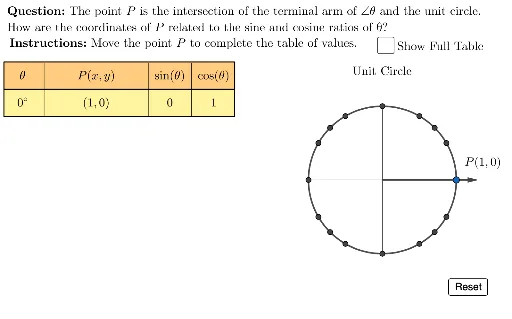
This example demonstrates how to visualize sine and cosine ratios on the unit circle through angles. It involves core math concepts like the unit circle, trigonometric functions, sine, and cosine ratios. Construction highlights the use of GeoGebra commands and objects such as Polygon, Zip, RemoveUndefined, Sort, Point, IndexOf, Sequence, Element, Translate, LaTeX, Segment, Angle, Length, TableText, and CurveCartesian. Suitable for high school students learning trigonometric definitions and properties.
GeoGebra Commands & Parameters
Polygon({Anchor1Box, Anchor1Box + u, Anchor1Box + u + (3.9 * v), Anchor1Box + (3.9 * v)}) → boxTemplateZip((((("\left(" * A) * ",") * B) * "\right)"), A, allCosVals, B, allSinVals) → allPointsDisplayRemoveUndefined(Sequence[If[Element[showRows, i], Element[allPointsDisplay, i]], i, 1, Length[allPointsDisplay]]) → displayPointsSort(Unique[Union[Sequence[i, i, 0, 360, 45], Sequence[i, i, 0, 360, 30]]]) → allAnglesZip(Rotate[(1, 0), A°, (0, 0)], A, allAngles) → allPointsPoint(allPoints) → PIndexOf(P, allPoints) → currIndxRemoveUndefined(Sequence[If[Element[showRows, i], If[currIndx ≟ i, "*", ""]], i, 1, Length[showRows]]) → rowPointerSequence(Translate[boxTemplate, Vector[(i * u)]], i, 0, Length[displayPoints]) → boxesElement(boxes, 2) → box1Element(boxes, 3) → box2Element(boxes, 4) → box3Element(boxes, 5) → box4Element(boxes, 6) → box5Element(boxes, 7) → box6Element(boxes, 8) → box7Element(boxes, 9) → box8Translate(boxTemplate, (2.5, 0)) → header2Element(allPoints, 1) → P1Element(allPoints, 2) → P2Element(allPoints, 3) → P3Element(allPoints, 4) → P4Element(allPoints, 5) → P5Element(allPoints, 6) → P6Element(allPoints, 7) → P7Element(allPoints, 8) → P8Element(allPoints, 9) → P9Element(allPoints, 10) → P10Element(allPoints, 11) → P11Element(allPoints, 12) → P12Element(allPoints, 13) → P13Element(allPoints, 14) → P14Element(allPoints, 15) → P15Element(allPoints, 16) → P16LaTeX("\text{\textbf{Question: }The point \(P\) is the intersection of the terminal arm of \(\angle θ\) and the unit circle.\\How are the coordinates of \(P\) related to the sine and cosine ratios of θ?}") → MainInstrucLaTeX("\text{\textbf{Instructions: }Move the point \(P\) to complete the table of values.}") → SpecInstrucSegment(P, (x(P), 0)) → oppositeSideAngle(Vector[(1, 0)], Vector[P]) → angleALaTeX("\text{Unit Circle}") → lblUnitCircleZip(((spacer * A) * "°"), A, allAngles) → allAngleDisplayRemoveUndefined(Sequence[If[Element[showRows, i], Element[allSinVals, i]], i, 1, Length[allSinVals]]) → displaySinValsRemoveUndefined(Sequence[If[Element[showRows, i], Element[allCosVals, i]], i, 1, Length[allCosVals]]) → displayCosValsRemoveUndefined(Sequence[If[Element[showRows, i], Element[allAngleDisplay, i]], i, 1, Length[allAngleDisplay]]) → displayAnglesLength(displayPoints) → testLaTeX(("P" * Element[allPointsDisplay, currIndx])) → lblPointTableText({Join[{{titleTheta}, displayAngles}], Join[{{titlePoints}, displayPoints}], Join[{{titleSin}, displaySinVals}], Join[{{titleCos}, displayCosVals}], Join[{{""}}]}, "|011100vc") → tableAZip(Rotate[A, Element[allAngles, currIndx]°, (0, 0)], A, {(0.25, -0.05), (0.3, 0), (0.35, -0.05)}) → chevronPointsSequence(Segment[Element[chevronPoints, i], Element[chevronPoints, i + 1]], i, 1, 2) → chevronCurveCartesian((0.3 * cos(((2 * π) * t))), (0.3 * sin(((2 * π) * t))), t, 0, Element[allAngles, currIndx] / 360) → angleCurvePolygon({(0, 0), (0.1, 0), (0.1, 0.1), (0, 0.1)}) → rightBoxTranslate(rightBox, (If[x(P) < 0, x(P), x(P) - 0.1], If[y(P) < 0, -0.1, 0])) → showRight