
Explore Exterior Angles Sum: Interactive Polygon Investigation
Loading the math board and drawing, please wait…
In collections
Exploring Interior and Exterior Angles of Polygons
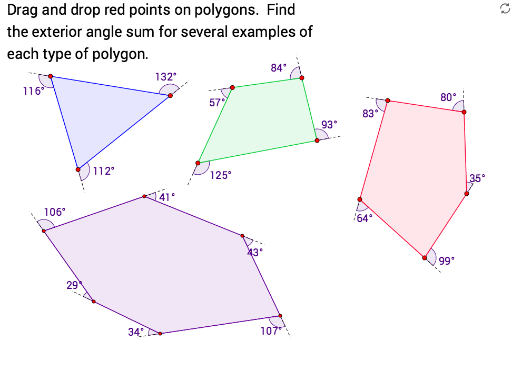
①This interactive GeoGebra example lets users drag polygon vertices to dynamically explore the theorem that the sum of exterior angles of any polygon is always 360°, while observing the supplementary relationship between interior and exterior angles. ②Core mathematical concepts include polygon interior angle sum, exterior angle theorem, adjacent supplementary angles, and dynamic angle measurement. ③Construction details: The example uses Polygon commands to create multiple polygons (poly1, poly2, poly3), Angle commands to label interior and exterior angles (θ, ι, κ, λ, μ), Segment and Vector commands to construct edges and direction vectors, and text1 to display the running sum of exterior angles. Points A, B, C, D, E, F, G, H, I, J, K, L, M, N, O, P, Q are draggable to reshape the polygons. ④This resource is ideal for middle school geometry lessons or high school review, serving as a dynamic classroom demonstration or a self-guided student exploration to verify the universality of the exterior angle sum theorem.
GeoGebra Commands & Parameters
Polygon(A, B, C) → poly1, c, a, bPolygon(D, E, F, G) → poly2, d, e, f, gPolygon(H, I, J, K, L) → poly3, h, i, j, k, lAngle(I, H, L) → θAngle(H, L, K) → ιAngle(L, K, J) → κAngle(K, J, I) → λAngle(J, I, H) → μSegment(M, N) → mSegment(N, Q) → nSegment(Q, O) → pSegment(O, R) → qSegment(R, P) → rSegment(P, M) → sPolygon(M, N, Q, O, R, P) → poly4, m_1, n_1, q_1, o, r_1, p_1Angle(P, M, N) → νAngle(M, N, Q) → ξAngle(N, Q, O) → οAngle(Q, O, R) → ρAngle(O, R, P) → σAngle(R, P, M) → τVector(A, B) → uSegment(B, S) → tVector(B, C) → vSegment(C, T) → a_1Vector(C, A) → wSegment(A, U) → b_1Angle(S, B, C) → υAngle(T, C, A) → ϕAngle(U, A, B) → χVector(D, E) → zVector(E, F) → u_1Vector(F, G) → v_1Vector(G, D) → w_1Segment(V, E) → c_1Segment(D, A_1) → d_1Segment(W, F) → e_1Segment(Z, G) → f_1Angle(V, E, F) → ψAngle(W, F, G) → ωAngle(Z, G, D) → α_1Angle(A_1, D, E) → β_1Vector(H, I) → z_1Vector(I, J) → g_1Vector(J, K) → h_1Vector(K, L) → i_1Vector(L, H) → j_1Vector(M, N) → k_1Vector(N, Q) → l_1Vector(Q, O) → s_1Vector(O, R) → t_1Vector(R, P) → u_2Vector(P, M) → v_2Segment(H, F_1) → a_2Segment(I, B_1) → b_2Segment(J, C_1) → c_2Segment(K, D_1) → d_2Segment(L, E_1) → e_2Segment(M, G_1) → f_2Segment(N, H_1) → g_2Segment(Q, I_1) → h_2Segment(O, J_1) → i_2Segment(R, K_1) → j_2Segment(P, L_1) → k_2Angle(F_1, H, I) → γ_1Angle(B_1, I, J) → δ_1Angle(C_1, J, K) → ε_1Angle(D_1, K, L) → ζ_1Angle(E_1, L, H) → η_1Angle(N, M, G_1) → θ_1Angle(Q, N, H_1) → ι_1Angle(O, Q, I_1) → κ_1Angle(R, O, J_1) → λ_1Angle(P, R, K_1) → μ_1Angle(M, P, L_1) → ν_1Angle(C, B, A) → αAngle(A, C, B) → βAngle(B, A, C) → γAngle(F, E, D) → δAngle(G, F, E) → εAngle(D, G, F) → ζAngle(E, D, G) → η
AI Drawing Prompt Reference
Create an interactive geometry diagram with three draggable polygons: a triangle, a quadrilateral, and a pentagon. Label all interior and exterior angles with arcs, and display a running sum showing exterior angles always total 360 degrees. Also include a hexagon with outward direction vectors on each side and exterior angles marked at every vertex. All vertices should be movable to dynamically update angle measurements and the sum.
The prompt above was compiled from the original drawing commands and is for reference only.