
Exploration of Law of Sines: 0, 1, and 2 Solution Cases
Loading the math board and drawing, please wait…
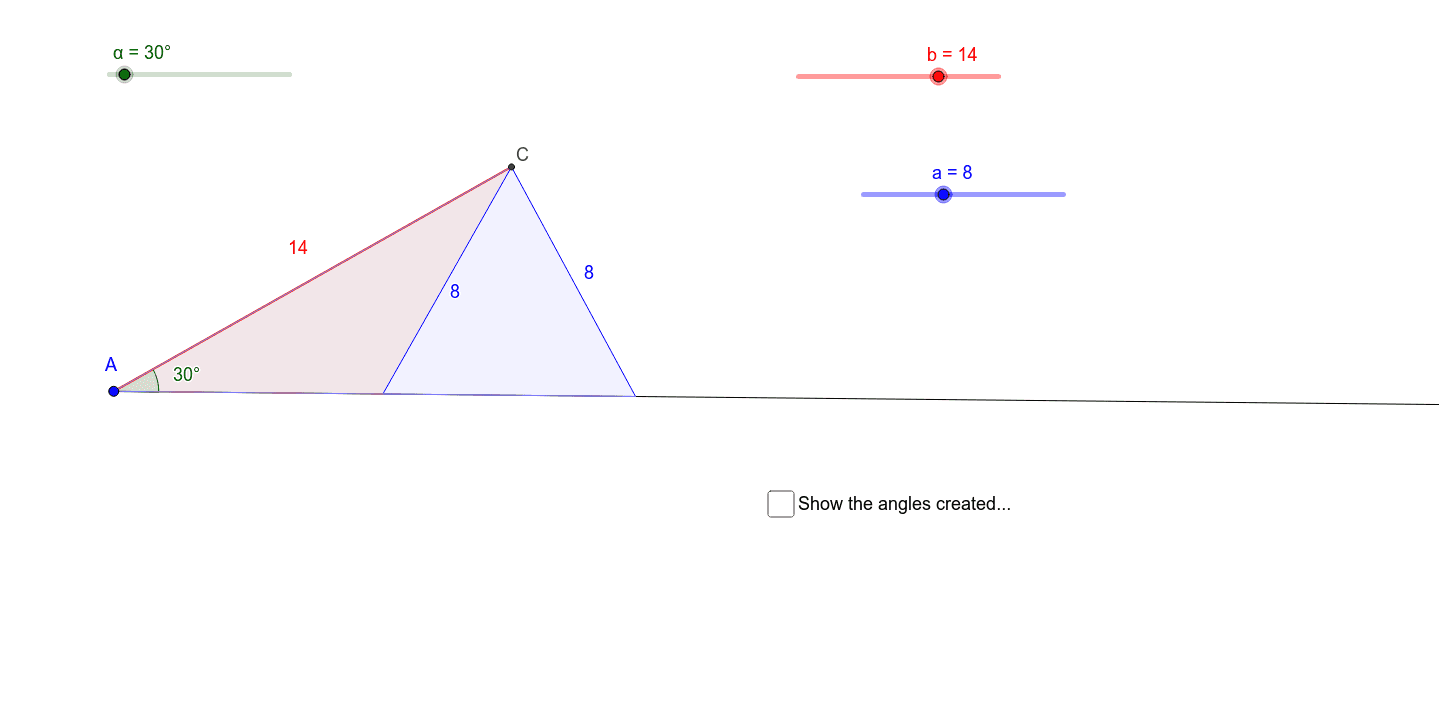
① This GeoGebra example dynamically illustrates the Law of Sines and its ambiguous case (SSA), showing how the number of possible triangles can be 0, 1, or 2 depending on given side lengths and an angle. ② Core mathematical concepts include the Law of Sines, triangle congruence conditions, the ambiguous case in solving triangles, and the analysis of intersection points in geometric constructions. ③ The construction uses GeoGebra commands such as Ray, Rotate, Angle, Circle, Intersect, Segment, and Polygon to create multiple triangles (poly1, poly2, etc.) and auxiliary lines. By adjusting the angle α or side lengths, the intersection points E and F change, visually demonstrating the varying number of solutions. ④ This is suitable for high school or early college students learning trigonometry and geometric construction, and for teachers to demonstrate the conditions under which the Law of Sines yields zero, one, or two solutions.
GeoGebra Commands & Parameters
Ray(A, B) → a_1Rotate(B, α, A) → B'Angle(B, A, B') → βRay(A, B') → b_1Circle(A, b) → c_1Intersect(c_1, b_1, 1) → CSegment(A, C) → dCircle(C, a) → cIntersect(c, a_1) → E, FPolygon(C, E, A) → poly1, a_2, c_2, e_1Polygon(C, F, A) → poly2, a_3, c_3, fAngle(C, E, A) → γAngle(C, F, A) → δAngle(A, C, F) → ε